Laser therapy for hair loss: effectiveness, limits and precautions

Low-level laser therapy for hair, also known as photobiomodulation, can improve hair density in some people with androgenetic alopecia. Its effect remains variable and calls for regular sessions over several months. It does not recreate a full head of hair on an area that has been bare for a long time, and it does not treat every cause of hair loss. Before buying a cap or booking a course of sessions, the decisive step is therefore to understand your diagnosis and the real place of this technique in your treatment plan.
Laser for hair: which technique are we talking about?
Photobiomodulation uses low-intensity light to influence the activity of the cells it reaches. In hair care, it often goes by the acronym LLLT, short for low-level light or laser therapy. Devices can take the form of a helmet, a cap, a comb or a unit used in a clinic.
They may use laser diodes, LEDs or a combination of light sources. Those words are not enough to describe the dose the scalp receives, nor the evidence of effectiveness for a given model. Wavelength, power, the area covered and the usage protocol all count together. A device with more diodes is not automatically more effective.
The aim is to support the activity of the follicles that are still there, not to destroy them. This technique therefore has to be distinguished from hair removal lasers, which aim to reduce hair growth, and from skin resurfacing lasers. A light device intended for the face or the body does not become a validated hair treatment simply because it emits red light.
The mechanisms put forward involve cell signalling and follicle activity in particular. They should not be presented as a certain repair of every miniaturised hair. A biological explanation helps you understand the hypothesis behind the treatment; clinical studies are what determine whether that hypothesis produces a measurable benefit in patients.
How effective is it according to the studies?
Positive results in some cases of androgenetic hair loss
A randomised trial published by Jimenez and colleagues in 2014 compared laser combs with sham devices in men and women with androgenetic pattern hair loss. After 26 weeks, the treated groups showed a greater increase in terminal hair count than the control groups. That result supports a possible benefit for the devices and the conditions studied.
It does not mean that everyone obtains a visible improvement, or that every cap on the market produces the same effect. An average difference between two groups leaves room for widely varying individual responses. The number of hairs counted in a small area does not fully describe overall scalp coverage or your own satisfaction.
A systematic review by Gentile and Garcovich, published in its final volume in 2024, also finds favourable results in the randomised trials it selected. This literature supports discussing photobiomodulation as a treatment option, while leaving open questions about protocols, about who responds best and about whether the benefit is maintained.
What these results do not demonstrate
A study on androgenetic alopecia does not prove effectiveness in scarring alopecia, in hair loss linked to a deficiency or in drug-induced shedding. The populations, the mechanisms and the objectives differ. Trials on one specific device also have to be distinguished from studies looking at light in general.
How long the research lasted is another important point. A benefit measured after several months does not demonstrate that it will persist for several years without treatment. The information published by the American Academy of Dermatology stresses that some people respond and others do not, and that further data is still needed.
Commercial photographs deserve the same caution. Hairstyle, hair length, lighting and the use of a thickening powder can strongly alter the visual impression. Ask as well whether a medicine or another procedure was used during the period shown. A genuine improvement may come from a combined treatment.
Who can consider a light treatment?
The discussion mainly concerns certain progressive forms of androgenetic hair loss, in men as well as in women. The dermatologist looks at the pattern of the loss, how long it has been going on, hair miniaturisation and the condition of the scalp. They then assess whether a reasonable improvement looks possible and which other options should be considered.
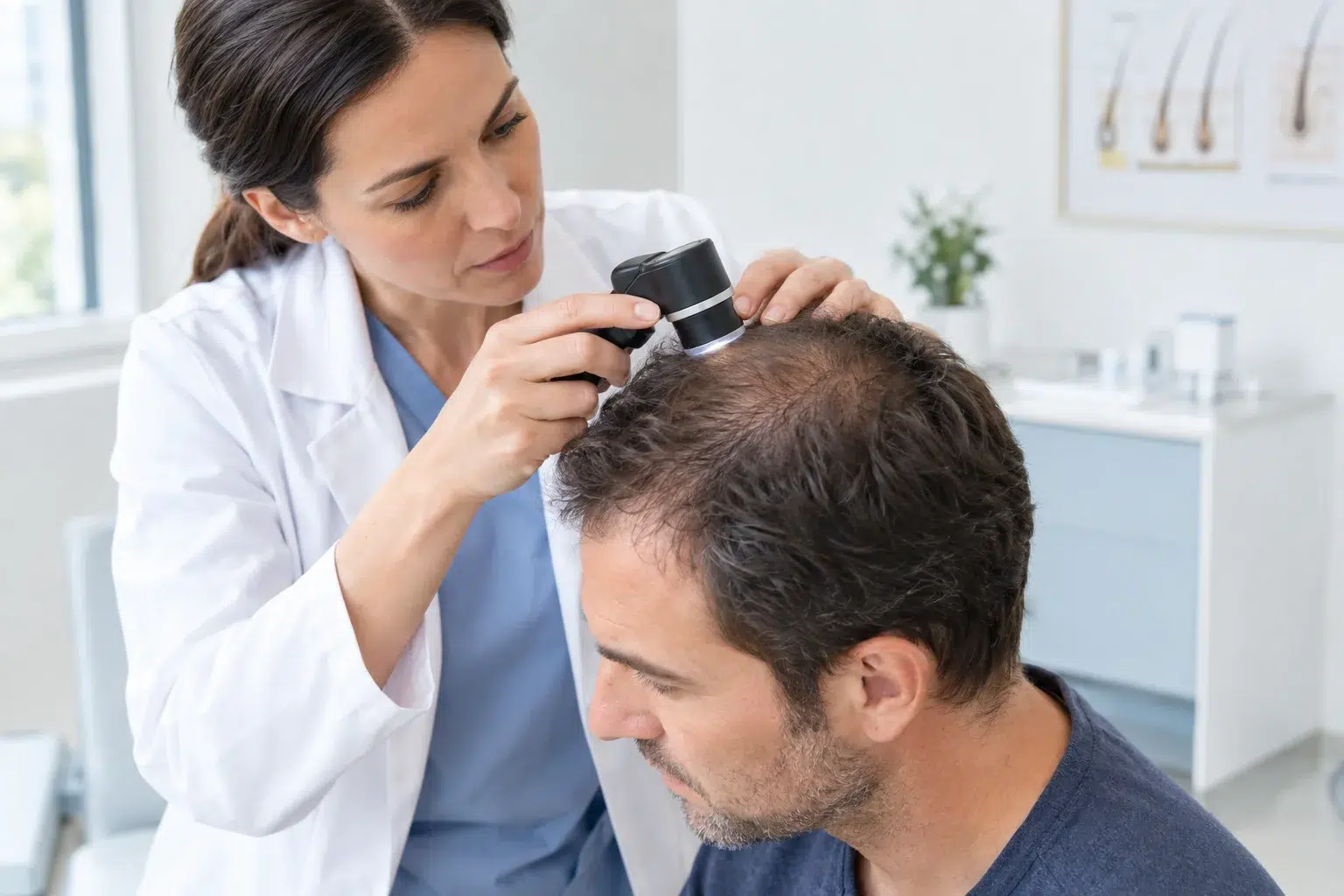
Thinning hair does not always have a single cause. Androgenetic alopecia can coexist with diffuse shedding after an illness, childbirth or a change of treatment. In that case, attributing every change to the laser risks masking the spontaneous recovery of one component or the worsening of another.
People with recent, diffuse shedding should not start by buying a device without understanding the context. A medical consultation can point towards targeted tests, depending on symptoms and history. Work-ups are not the same for everyone; they answer a clinical hypothesis rather than a standard package of tests.
An area that has been bare for a long time raises a different question. Light does not transplant follicles and cannot promise the reconstruction of a frontal hairline. Whether a hair transplant is possible depends on a separate assessment, in particular of the donor area, the stability of the loss and your expectations.
Situations where diagnosis comes first
Patchy hair loss, scalp pain, pustules, persistent inflammation or the apparent disappearance of the follicular openings calls for a dermatological opinion. Some diseases can damage follicles permanently and need specific treatment. A light protocol must not delay that care.
Sudden shedding combined with unusual tiredness, weight loss or other symptoms should also be discussed with a doctor. Looking for a general cause may matter more than a local treatment. Report any new medicines and any events from the preceding months, without stopping a prescribed treatment on your own.
In women, the assessment can include hormonal variations and other clinical signs, depending on the situation. The AAD describes an individualised approach to female hair loss, in which light devices are only one option among several. A precise diagnosis makes it possible to discuss their value without overlooking the medical alternatives.
How does a course of treatment work?
In the clinic, the first step should be assessing the scalp and setting a goal. The practitioner explains the device used, the number of sessions planned, how often they take place and how progress will be checked. An initial photograph and, where useful, a density measurement give you a point of comparison.
At home, the protocol depends on the model’s instructions and on the recommendations you have been given. Some of the devices studied are used several times a week, but that frequency should not be transferred automatically to another model. Session length and dose are linked; extending the exposure to speed up regrowth is not a validated strategy.
Positioning has to let the light reach the scalp in line with the way the device was designed. Very dense hair, accessories or careless use can make that exposure harder to achieve. Ask for a demonstration if the device requires you to move a comb across the scalp or to treat several areas one after another.
Regularity is a real constraint. Before committing, look at how the sessions fit into your week, who will handle the follow-up and what will happen while you are away. A protocol that is too hard to keep to may be of little practical use, even if the device has favourable data under study conditions.
When and how should the results be assessed?
The hair cycle takes time. A feeling that shedding has slowed after a few uses does not allow you to conclude that the treatment has caused regrowth. Trials generally assess effects after several months; your doctor should set a review point consistent with the device and the other treatments in use.
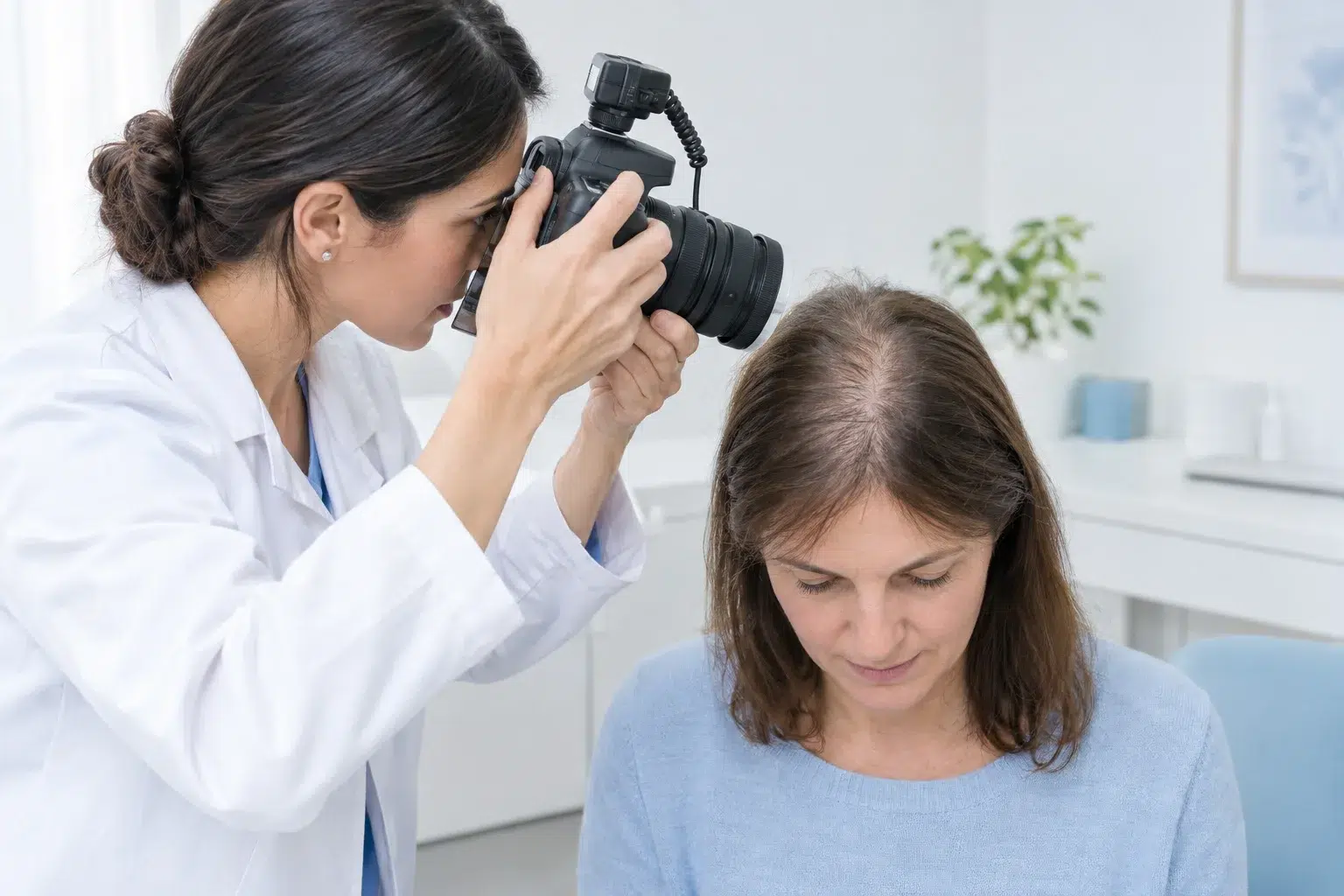
Take the photographs in reproducible conditions: same hairstyle, same length as far as possible, same lighting and same angle. The parting should be in the same place. Avoid judging density from a shot of wet hair compared with a photo of dry hair, because that difference alone is enough to change the impression of coverage.
Hair counts and a scalp examination can add to your own impression. Even so, you need to decide in advance what would count as a useful benefit for you. A small measured improvement can be worthwhile if your priority is stabilisation, but disappointing if you expect density well above your starting point.
If no satisfactory change appears at the agreed review, the doctor can check adherence, the diagnosis and the other factors behind the loss. That does not mean buying a more powerful device or piling up sessions. Changing strategy, or stopping, can be reasonable once your goals and the alternatives have been discussed.
Should the laser be continued over the long term?
Photobiomodulation does not necessarily remove the mechanism behind androgenetic alopecia. Maintenance may be needed to keep a benefit, but there is no single approach that suits everyone. The AAD points out the need for regular use and follow-up, with responses that vary from person to person.
Before you buy, ask how the decision to continue will be made: maintenance frequency, criteria for stopping and review appointments. An open-ended programme with no review date makes its value hard to judge. The cost in time, tolerance and satisfaction matter as much as density measurements.
An improvement is not a reason to drop an associated treatment on your own initiative. If you are also using a medicine, the whole result cannot be put down to the light. Your doctor can explain why a combination should be kept or, in some situations, how to reassess its components separately without compromising the monitoring of your hair loss.
Laser, medicines, PRP and transplantation: distinct roles
Medicines prescribed for certain forms of alopecia work through their own mechanisms and their own indications. Light may be offered alongside them or in particular situations, but it does not automatically replace a medical strategy that is working. The side effects and the constraints of each option have to be discussed case by case.
PRP, obtained from your own blood and then injected, is another approach studied in some forms of hair loss. It involves a blood draw and injections, unlike photobiomodulation. A combination should not be chosen simply because it multiplies theoretical mechanisms: you need to understand the expected benefit of each component and how it will be measured.
A transplant moves follicles from a donor area to an area that needs covering. The laser targets the activity of follicles that are already present. Those aims explain why an improvement in density under light treatment is not equivalent to the surgical creation of a new hairline. The two approaches can sometimes belong to the same pathway, with distinct indications.
After a transplant, any use of a cap or a device on the scalp has to be approved by the surgeon. Pressure, rubbing and the healing timetable all count. The data on photobiomodulation does not allow anyone to promise better graft survival, faster regrowth or fewer complications for every patient.
Tolerance and precautions for use
The available studies generally report good tolerance under the conditions assessed. That does not mean side effects are impossible. Irritation, redness, discomfort or unusual symptoms during the sessions should lead you to stop using the device and seek advice, especially if they persist or get worse.
Eye protection rules depend on the device. Follow its instructions and do not look directly at the light sources. Do not modify the device and do not use one that is damaged. A stated low intensity does not exempt you from the precautions set out by the manufacturer and by the professional looking after you.
Conditions associated with photosensitivity and photosensitising medicines need to be checked. Also mention any scalp disorder, any history of skin cancer in the area or any recent procedure. Your doctor may judge that a prior examination or a postponement is necessary, depending on the context.
The data may be insufficient during pregnancy and breastfeeding, and for certain profiles that have not been studied. Check the instructions and ask for advice rather than inferring safety from the absence of injections. Conversely, it would be inaccurate to turn every chronic illness into an absolute contraindication that applies identically to all devices.
Choosing a device: what should you ask about?
Start with the intended use and the data specific to the model. Ask whether a study has assessed this device or only a related technology, in which type of alopecia and with which protocol. A scientific paper quoted on a commercial page may concern a different device; the name, the settings and the population should be traceable back to what is being offered.

The Société Française des Lasers en Dermatologie, the French dermatological laser society, recommends caution with home-use devices and stresses the value of a dermatologist’s opinion. Its 2023 factsheet points in particular to the small size of some hair studies and to the fact that manufacturers often fund them. Ease of purchase replaces neither the diagnosis nor the reading of the precautions. The other treatments available should also be open to discussion.
A regulatory mention is not a guarantee of regrowth for you personally. Ask what it covers for the exact model, what its indication is and which country it applies to. Words such as ‘certified’, ‘approved’ or ‘medical’, used without a precise document, make it impossible to compare devices properly.
Then check the practical side: fit on your head, coverage of the areas concerned, comfort, maintenance, repair and return conditions. These are useful criteria for keeping to the protocol over time. They should add to the clinical assessment, without replacing effectiveness data with a comparison of design or diode count.
Cost of the sessions and the value of treatment in Turkey
The total cost depends on the number of sessions, how often they take place, how long maintenance lasts and which consultations are needed. For a home device, add the maintenance requirements and the medical follow-up. A price per session can look affordable while adding up to significant spending over several months; ask for an estimate of the pathway being proposed.
If you travel to Turkey, a few sessions during a short stay do not reproduce the extended protocols assessed in the trials. The plan has to explain how you will continue the treatment once you are home and how the results will be checked. The trip has no particular medical value if that continuity is not organised.
No old price should be treated as a current quote. Ask what covers the assessment, the sessions and any associated treatments. A treatment added to a transplant programme must keep its own indication and should not be presented as essential to success without clinical justification.
Common questions about laser treatment for hair
Does the laser regrow hair on long-standing baldness?
It cannot promise new coverage on an area that has been bare for a long time. The potential depends on the follicles still present and on the cause of the loss. A consultation helps distinguish miniaturisation that may respond to treatment from an area where the options are different.
Is an LED cap necessarily equivalent to a laser cap?
The light sources differ, but the name of the technology is not enough to classify devices. The settings, the actual exposure of the scalp and the studies specific to the model are what count. Compare relevant clinical evidence and a precise protocol rather than a general claim that one light is superior to another.
Does a longer session give better results?
Duration is part of a defined dose. Extending it beyond the recommendations is not a proven way to increase the benefit. Follow the instructions and the agreed programme; if you miss sessions, ask how to resume rather than multiplying exposures to make up for them.
Sources
- Jimenez, J. J., Wikramanayake, T. C., Bergfeld, W., Hordinsky, M., Hickman, J. G., Hamblin, M. R., & Schachner, L. A. (2014). Efficacy and safety of a low-level laser device in the treatment of male and female pattern hair loss: A multicenter, randomized, sham device-controlled, double-blind study. American Journal of Clinical Dermatology, 15(2), 115–127. https://doi.org/10.1007/s40257-013-0060-6
- Gentile, P., & Garcovich, S. (2024). The effectiveness of low-level light/laser therapy on hair loss. Facial Plastic Surgery & Aesthetic Medicine, 26(2), 228–235. https://doi.org/10.1089/fpsam.2021.0151
- American Academy of Dermatology Association. (s. d.). Hair loss: Diagnosis and treatment. https://www.aad.org/public/diseases/hair-loss/treatment/diagnosis-treat
- American Academy of Dermatology Association. (s. d.). Thinning hair and hair loss: Could it be female pattern hair loss? https://www.aad.org/public/diseases/hair-loss/types/female-pattern
- American Academy of Dermatology Association. (s. d.). Is red light therapy right for your skin? https://www.aad.org/public/cosmetic/safety/red-light-therapy
- Société Française des Lasers en Dermatologie. (2023, 23 mai). Les appareils à usage domestique (Home Use Devices = HUD). https://www.sfldlaser.com/upload/fichepratiques/1693-Appareils-yy-Usage-Domestique-.pdf