Chin implant: all about mentoplasty
A chin that sits a little too far back, and the whole profile loses its balance. A chin implant, or mentoplasty, gives the area the projection it lacks, using a prosthesis chosen to suit your face. The facial surgeons at our partner clinic stay with you at every step, from the first consultation to the final check-up. Here’s what matters, so you can go into the procedure with a clear mind.
The chin implant at a glance

Why consider a chin implant?
A chin that sits slightly too far back is sometimes enough to throw the whole face off balance, even when the nose, eyes and cheekbones are in good proportion. A mentoplasty corrects that imbalance: it gives the chin a natural projection, for a stronger profile and a better-defined lower face.

Quiet for a long time, it is now more often chosen for overall harmony than for a dramatic change. Many patients think about it as part of a wider plan, alongside a rhinoplasty in Turkey or other cosmetic surgery procedures.
The mentoplasty journey, from consultation to recovery
Your surgeon looks at the proportions of your face, takes photos from several angles and may use 3D simulation to show you the likely result. You talk through what you’re hoping for, and they explain both the benefits and the limits of the procedure.
You have a blood test and facial imaging. You’ll need to stop smoking at least four weeks beforehand, pause certain medications and follow a pre-operative fast.
The implant goes in within 30 to 45 minutes, under local anaesthetic with sedation or general anaesthetic. The incision is usually made inside the mouth, with no visible scar, before the prosthesis is set in place and fixed.
You apply cold to keep the swelling down and keep your head raised. Any pain is moderate and eased by painkillers. Soft food and careful mouth hygiene help the healing along.
Regular check-ups are booked over the first few weeks to make sure the implant is settling well. Our team stays on hand to reassure you, including once you’re back home.
You’re back at work within 1 to 2 weeks, and back to sport gradually, from 4 weeks. If the incision was under the chin, sun protection on the scar is advised while it fades.

Want a more balanced profile?
Our coordinators will look at your plan and call you back within 24h.
The different types of chin implant
-
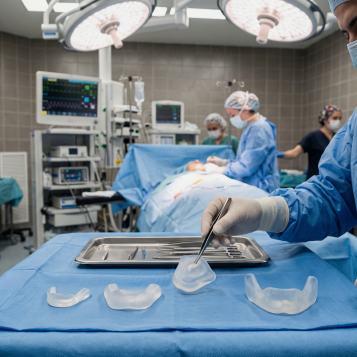 Silicone implants
Soft and biocompatible, they feel natural and adapt easily to the shape of the chin. Easy to place and to remove, they remain the most widely used option.
-
 Porous polyethylene (Medpor)
Its porous structure lets tissue grow into the implant, which gives excellent stability over time. A favoured option for lasting integration.
-
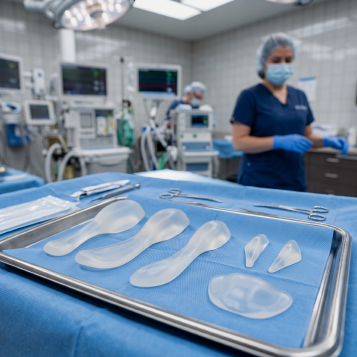 Custom-made implants
Designed from a 3D scan of the face, they follow your contours precisely. Maximum personalisation in the service of a natural result.


Common questions about the chin implant
Who is a chin implant suitable for?
The procedure suits adults in good health whose chin lacks projection (a receding chin, or microgenia), with realistic expectations and no medical contraindication.
Does a chin implant leave a scar?
In most cases the incision is made inside the mouth, so no scar is visible. If an external route under the chin is used, the scar stays very discreet.
When will I see the final result?
The profile changes straight away, but the swelling settles gradually. Most of the swelling has gone by 4 to 6 weeks; the final result is usually clear after 3 to 6 months.
Mentoplasty or genioplasty: what’s the difference?
An alloplastic chin augmentation (mentoplasty) relies on a prosthesis, whereas a sliding genioplasty moves the chin bone itself. The right choice depends on your face and the corrections you’re after.
Can it be combined with other procedures?
It is often paired with a rhinoplasty (a profiloplasty) or with chin liposuction to redraw the lower face.
Why have your mentoplasty in Turkey?
Turkey is one of the world’s leading destinations for cosmetic medical tourism: qualified surgeons, modern clinics, full English-speaking support and up to 70% savings compared with the UK. See also buccal fat removal in Turkey.
Let’s discuss your project

The chin implant in detail
The chin, a cornerstone of facial harmony
We rarely think of the chin when we talk about a good-looking face, and yet it’s one of its pillars. Sitting where the face meets the neck, it shapes the whole lower third of the face and gives the profile its character. A well-projected chin reads as balance and self-assurance, while a chin that’s too slight can throw the features off, even when the nose and eyes are perfectly proportioned. That’s exactly what the chin implant, or mentoplasty, sets out to correct.

Understanding the receding chin
When the chin lacks forward projection, we talk about a receding chin or microgenia. It can be constitutional, there from birth, or come on with time, as the tissue and bone lose density. The effects are mostly aesthetic: the nose looks more prominent, the jaw less defined, the lower face less firm. By restoring the natural projection of the area, the implant brings back a clean jawline and a better-balanced profile.

Who is mentoplasty for?
Augmentation mentoplasty suits both men and women bothered by a chin that sits too far back. It’s for adults in good health, with realistic expectations. Very often it’s part of a wider plan for harmony: paired with a rhinoplasty as part of a profiloplasty, with a face lift to firm up the oval of the face, or with double chin liposuction to slim the area beneath the chin, it lets the surgeon rework the whole lower face so it hangs together.

The different implant materials
The choice of material weighs heavily on the quality and the durability of the result. Silicone implants, soft and biocompatible, feel natural and are easy to place and to remove. Porous polyethylene, such as Medpor, has a structure that tissue slowly grows into, which gives it remarkable stability over the years. A 2025 systematic review of facial implants, covering more than 4000 patients, found polyethylene among the materials with the fewest complications. Custom-made implants, shaped from a 3D scan of the face, follow your contours precisely for the most personalised result. Your surgeon will point you towards the option that best fits your anatomy and your goals.

How the procedure works
The procedure is short, in the region of thirty to forty-five minutes. It’s done under local anaesthetic with sedation or under general anaesthetic, depending on the medical picture and what you’d prefer. Most often the surgeon makes an incision inside the mouth, which avoids any visible scar, then fashions a pocket against the bone where the prosthesis is set in place and fixed with care. An external route, under the chin, is sometimes chosen instead; the scar then stays very discreet and soon fades.

Recovery, day to day
The first few days ask for a handful of simple but real precautions. Cold applied to the area keeps the swelling down, keeping your head raised helps it go, and ordinary painkillers are enough for what is usually mild discomfort. Soft food and careful mouth hygiene go hand in hand with healing. You’re back at work in one to two weeks, and back to sport gradually, from the fourth week.

The risks worth knowing
As with any surgery, placing an implant carries risks that are rare but real, and they’re worth knowing before you decide:
- infection at the surgical site
- movement or poor positioning of the prosthesis
- an asymmetry in the result
- brief changes in sensation linked to the mental nerve
The figures are reassuring. A systematic review of more than 3000 patients found that complications after a first-time mentoplasty run at around 3 to 5% for the most-used materials (silicone, porous polyethylene). Most events stay local: infection, a shift of the implant or a change in sensation. Some settle with treatment; others need a revision. The real safeguard is picking an experienced team and a partner clinic selected for its facilities.

How the result holds up over time
A mentoplasty gives a lasting result. Unlike injectables, the implant doesn’t dissolve and keeps its shape year after year. The natural ageing of the tissue around it may, over the very long run, call for a small adjustment or a repositioning of the prosthesis. The profile already looks much clearer after 4 to 6 weeks. The final result shows once the last of the swelling has gone, usually after 3 to 6 months.

Mentoplasty or genioplasty: how do you choose?
Two main routes correct a receding chin. Alloplastic chin augmentation (mentoplasty) rests on a prosthesis placed against the bone, whereas sliding genioplasty means cutting and then repositioning the chin bone itself. The first is simpler, quicker and reversible; the second allows bigger corrections, especially when the gap is marked. A bite problem calls for orthognathic surgery, not an isolated genioplasty. Your surgeon will work out the most fitting option with you, based on your anatomy.

What are the alternatives to an implant?
When the correction called for stays modest, gentler approaches are worth considering:
- hyaluronic acid injections, with an immediate but temporary result
- lipofilling, which uses your own fat for a very natural look
- bone surgery, for the more complex cases
Each option has its upsides and its limits, and only a one-to-one consultation can pin down the right strategy for your face.

Why have your mentoplasty in Turkey?
Turkey has grown into one of the world’s leading destinations for cosmetic medical tourism, and that’s no accident. Highly qualified surgeons operate here, in modern clinics kitted out with the latest technology, with full English-speaking support from the first conversation through to your follow-up once you’re home. On budget, the gap is real: up to 70% savings against UK prices, as the price table higher up this page lays out, and without cutting corners on care.
Want a clearer picture of your own case? Our coordinators will put together a free, personalised quote within 24h, from a few photos and a short chat.

In summary
The chin plays a quiet but decisive part in the balance of the face. When it lacks projection, we talk about a receding chin or microgenia, and it’s often the whole profile that suffers: the nose looks stronger, the jaw less clean. A mentoplasty, or the fitting of a chin implant, corrects that imbalance by giving the area a natural, lasting projection. The procedure is short, around thirty minutes, usually with an incision tucked inside the mouth, so no visible scar. You’re back at work in one to two weeks, and the final result reads once the swelling has settled, around the sixth week.
Depending on your anatomy, your surgeon will steer you towards a silicone, porous polyethylene or custom-made implant, or towards bone genioplasty if the gap is marked. Complications stay rare and, in the vast majority, minor. That leaves the choice of team: that’s the thing that makes the difference.
At Body Expert, you get experienced facial surgeons, partner clinics selected against our quality criteria, English-speaking support from start to finish and up to 70% savings compared with the UK. A question, a doubt about your profile? Get a free, personalised quote within 24h, with no obligation.
Sources and references
- Liao, C. D., Rodriguez, E., Zhao, K., Kunda, N., & George, F. (2023). Complications following alloplastic chin augmentation: A systematic review of implant materials and surgical techniques. Annals of Plastic Surgery, 90(6S Suppl 5), S515-S520. https://doi.org/10.1097/SAP.0000000000003423
- International Society of Aesthetic Plastic Surgery. (2024). ISAPS international survey on aesthetic/cosmetic procedures performed in 2023. https://www.isaps.org/discover/about-isaps/global-statistics/global-survey-2023-full-report-and-press-releases/
- Kauke-Navarro, M., Knoedler, L., Baecher, H., Sherwani, K., Knoedler, S., Allam, O., Diatta, F., Alperovich, M., & Safi, A.-F. (2025). A systematic review of implant materials for facial reconstructive and aesthetic surgery. Frontiers in Surgery, 12, 1548597. https://doi.org/10.3389/fsurg.2025.1548597
OUR ARTICLES ON Cosmetic surgery
-

-
-

-

-
 Breast enhancement and dental crowns in Istanbul: Marie and Océanie tell their story on RTL TVI
 -

-

-