Implants for a full jaw in Turkey: a guide

Replacing every tooth in one jaw with implants in Turkey means choosing a prosthetic solution, preparing for surgery and organising several follow-up stages. The names All-on-4 and All-on-6 describe a number of implants supporting an arch, but they are not enough to define your treatment. Teeth that can still be saved, bone volume, the condition of your gums, the temporary prosthesis and future maintenance all need to be discussed before the price or the travel dates.
What does ‘implants for a full jaw’ mean?
An arch is the whole set of upper or lower teeth. A full-jaw treatment therefore concerns a single arch, unless both are explicitly mentioned. That detail changes the way a quote reads: six implants in total and six implants per arch are not the same project.
An implant is an artificial root placed in the bone. An abutment provides the connection with the prosthesis. In a full restoration, several implants can support a bridge carrying an entire row of teeth. It is generally not necessary to place one implant for every tooth replaced. The number of prosthetic teeth, the number of implants and the number of items invoiced should nevertheless be listed separately. The FDA describes these different parts of the implant system in its information for patients.
The phrase ‘having all your teeth redone’ also covers other situations: restoring natural teeth with crowns, replacing only some teeth, or stabilising a removable denture. A photograph of a smile cannot tell these needs apart. Our dental care section helps you put these options in context before you consider a full implant rehabilitation.
Do the remaining teeth have to be extracted?
Losing many teeth does not automatically mean extracting all the rest. Every remaining tooth deserves an assessment: the state of its root, how much tissue can be kept, gum disease, its position and the part it could play in the restoration. When extractions are proposed, the reasoning should be explained tooth by tooth.
The ITI recommends including tooth preservation among the options discussed with the patient. Its consensus on full-arch restorations does not present total extraction as a universal shortcut. An irreversible decision should come with a clinical justification you can understand.
Ask what could be kept, with what prognosis and what constraints. If several teeth still seem functional, an independent second opinion can help you compare preservation, partial treatment and full rehabilitation. The point is not to keep a tooth with no future at all costs, but to understand why extracting it would bring a greater benefit than the alternatives.
You should be able to leave with that explanation before you decide. A proposal received by email or messaging app can prepare the consultation; it does not replace the clinical examination that confirms whether teeth can be kept.
Fixed bridge or removable denture on implants?
The fixed full-arch bridge
A bridge fixed onto several implants stays in the mouth day to day. You do not take it out to sleep or to clean it. The practitioner may still need to remove it for certain repairs or maintenance work: ‘fixed’ therefore does not mean permanently inaccessible.
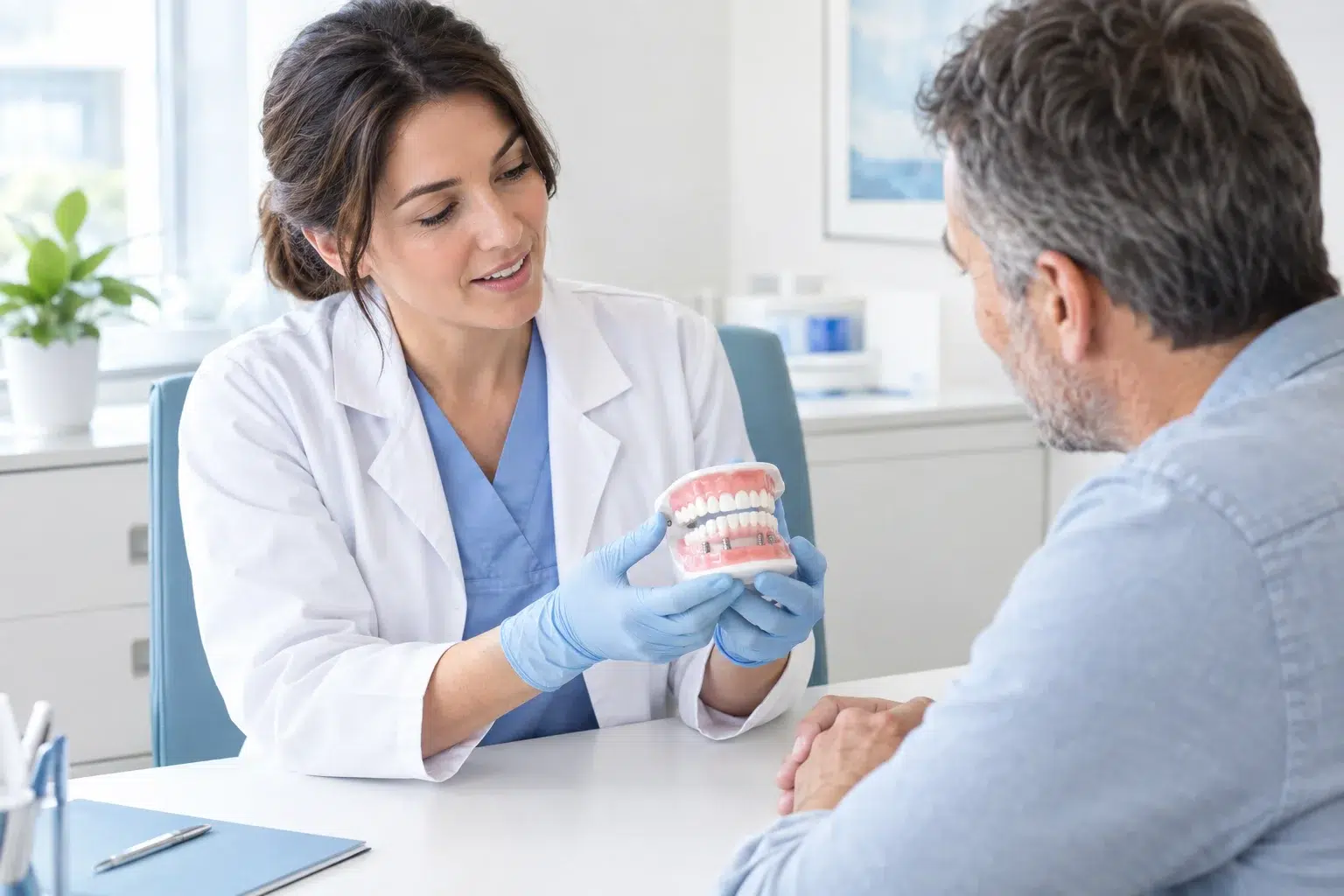
This solution can answer a wish for stability and comfort. It does call for a design that allows cleaning underneath the prosthesis. The volume required, lip support, the look of the junction with the gum and the way the teeth meet count as much as the shade of the smile.
The removable denture stabilised by implants
A removable denture can clip onto implants using attachments. You take it out yourself, in particular to clean it. It is a genuine treatment option, to be weighed up according to your anatomy, your ability to clean and your budget.
Patient-reported outcomes can improve with both types of treatment. The ITI overview of implant-supported overdentures underlines their value, particularly in the lower jaw. Results obtained with a removable denture retained by two implants should not be transferred to a full fixed bridge.
Before choosing, ask for a demonstration on a model. Handling an attachment or seeing how an interdental brush passes through often makes clear a difference that commercial photographs convey poorly.
All-on-4 or All-on-6: how is the choice made?
The two names describe full restorations supported by four and six implants respectively. They do not stand for two automatic levels of quality. Four implants do not mean a ‘half denture’; six implants do not on their own guarantee a longer lifespan.
The practitioner chooses their number and their distribution from the bone available, the prosthetic space, chewing forces and the final plan. Whether the restoration can be repaired or adapted if a problem arises also enters the discussion. The ITI consensus cited above recommends at least four properly distributed implants for a one-piece full fixed prosthesis, while calling for individual planning.
A useful comparison therefore rests on concrete questions: where will the implants be placed, why that distribution, which prosthesis will be fixed on top and what happens if one implant fails to integrate? The explanation should stay understandable without asking you to choose a surgical technique yourself.
A quote that simply says ‘All-on’ remains incomplete. Ask for it to specify the arch treated, the number of implants planned, the type of bridge and any changes envisaged after the examination. The prosthetic plan should guide the surgery, not be improvised once the implants are in place.
What assessment should be done before travelling?
The assessment brings together your expectations, the oral examination, analysis of the gums and whatever imaging is indicated. A panoramic X-ray gives an overall view. A three-dimensional CBCT scan may be needed to study the bone, the nerves and the sinuses. The Leeds Teaching Hospitals document explains this preparation and the role of imaging in locating anatomical structures.
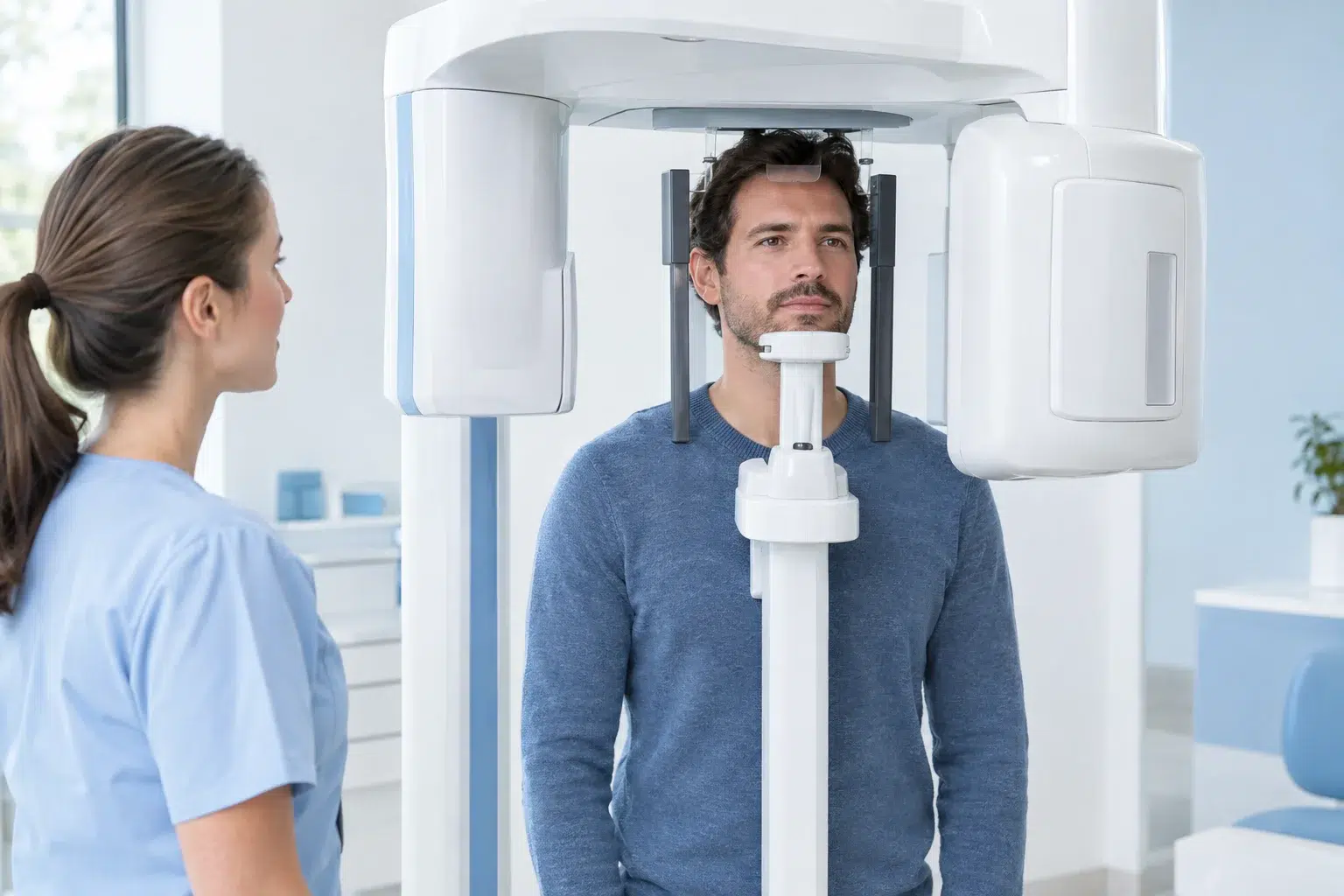
Pass on your medical history, treatments, allergies and any dental records you have. Mention smoking, diabetes, bleeding problems and any treatment likely to influence the surgery or healing. Do not stop any medicine on your own initiative: that decision belongs to the professionals looking after you.
Being able to come back for appointments is part of the plan. If your work, your health or your family situation limits travel considerably, say so from the start. A solution that is technically possible can still be hard to follow through in your own circumstances.
Finally, ask who makes the diagnosis, who operates and who makes the prosthesis. The interpreter or coordinator makes communication easier; clinical decisions should be open to discussion directly with a dentist, in a language you understand.
Not enough bone: is a graft always needed?
Missing teeth can go together with a reduction in bone volume. The need for reconstruction depends on how much bone is left and on where the implants are planned. It cannot be deduced from your age or from the number of years since the extractions.
Depending on the case, adapting the implant plan can avoid bone augmentation. In other situations, a graft remains indicated to make the project feasible. A dental bone graft can be carried out at the same time as the implants are placed, or it may require a preliminary stage and extra waiting time.
In the upper jaw, the sinuses are a particular anatomical constraint. In the lower jaw, the path of the nerve has to be respected. These differences explain why the plan for the top is not necessarily the plan for the bottom.
If two teams propose different solutions, ask about the expected benefit and the limits of each. ‘No graft needed’ is not a sufficient goal if the position of the implants then complicates cleaning or the prosthesis. Conversely, extensive reconstruction should have a justification proportionate to the result being sought.
Can you be given fixed teeth during the first stay?
Immediate loading is a possibility under certain conditions, not a promise that holds for everyone. It involves connecting a prosthesis to the implants quickly. Whether it is feasible depends in particular on their initial stability and on the overall plan. The ITI insists on selecting suitable situations and on checking that stability in its consensus on loading protocols in edentulous jaws.
A prosthesis fitted quickly is often a temporary one. It does not mean that bone integration is complete, nor that you can immediately go back to eating without restrictions. Biological healing carries on even though teeth are already visible.
The plan should set out what happens if immediate loading turns out not to be possible. Ask which temporary solution would be offered, in particular whether it would be removable, and what dietary adjustments would be needed. Have the consequences for the timetable and the cost spelt out before the procedure, so that this possibility is understood and accepted.
Do not confuse immediate implant placement after extraction with immediate loading either. An implant can be placed in the same session as the extraction without receiving a functional prosthesis straight away. These are two separate decisions.
How many stages should you expect for the whole treatment?
The pathway usually includes preparation, surgery, a healing period, then the making and fitting of the final restoration. Each stage can involve several appointments. Guy’s and St Thomas’ NHS Foundation Trust describes treatment that can extend over several months, with different visits depending on the care needed.
The number of trips is therefore not enough to sum up how long it takes. Two stays can be separated by a long biological wait. A preliminary graft, slower healing or an adjustment to the prosthesis can change the original programme.
During the prosthetic phase, the try-ins serve to check the shape, your speech, the contacts between the teeth and the appearance of the smile. Report anything specific that bothers you: difficulty with certain sounds, biting your cheek, the feeling that one side meets before the other. Approving the look should go together with a functional check.
Allow some margin when organising the trip and ask when a check-up should take place before you leave. A plane ticket should not force a clinical stage to be cut short. The conditions for travelling home depend on the procedures carried out and on how you are after the operation.
Temporary, zirconia, resin: what should you compare?
The material is one element of the plan, but its name does not describe the whole restoration. A bridge can combine several components: a framework, prosthetic teeth, a part imitating the gum and fixing elements. The terms used in the quote should correspond to clearly identifiable parts.
Ask which materials apply to the temporary prosthesis and which to the final one. Have it specified whether the restoration is one piece or made up of several segments, how it will be repaired and whether the parts needed will remain available. A brand name on its own does not answer these questions.
The choice also has to take account of the space available and of the opposing teeth. A solution presented as the most attractive in a photograph is not automatically the best suited to your bite. Ask why the material proposed suits your situation and what constraints it brings.
The document handed over at the end of treatment should identify the implants and components used. Keep this file together with the X-rays and the team’s contact details. For a future practitioner, the brand and the exact reference are more useful than a general phrase such as ‘premium implants’.
Recovery and signs that call for a check-up
Implant surgery can cause pain, swelling, bruising and difficulty eating. How marked these are varies with the extent of the procedure. Make sure you receive written instructions about the medicines prescribed, cleaning, diet and who to contact if there is a problem.
Pain that gets worse, significant or increasing swelling, discharge, fever or a feeling of movement are reasons to contact a professional quickly. Bleeding that does not stop despite the measures advised also needs assessment. Difficulty breathing or swallowing is an emergency.
Persistent loss of sensation should be reported. The anatomical risks include nerve or sinus involvement, depending on the area operated on. A failure of bone integration can also lead to an implant being removed or replaced. The everyday word ‘rejection’ does not, on its own, explain the cause of a failure.
Once you are home, do not put off a consultation you need while waiting for another trip. Remote follow-up can guide what to do, but a photograph does not replace an examination when a complication is suspected.
How do you look after a full arch on implants?
Artificial teeth do not decay, but the tissues surrounding implants can become inflamed. The European Federation of Periodontology distinguishes peri-implant mucositis, which affects the soft tissues, from peri-implantitis, which is associated with bone loss. A history of periodontitis calls for particular vigilance.
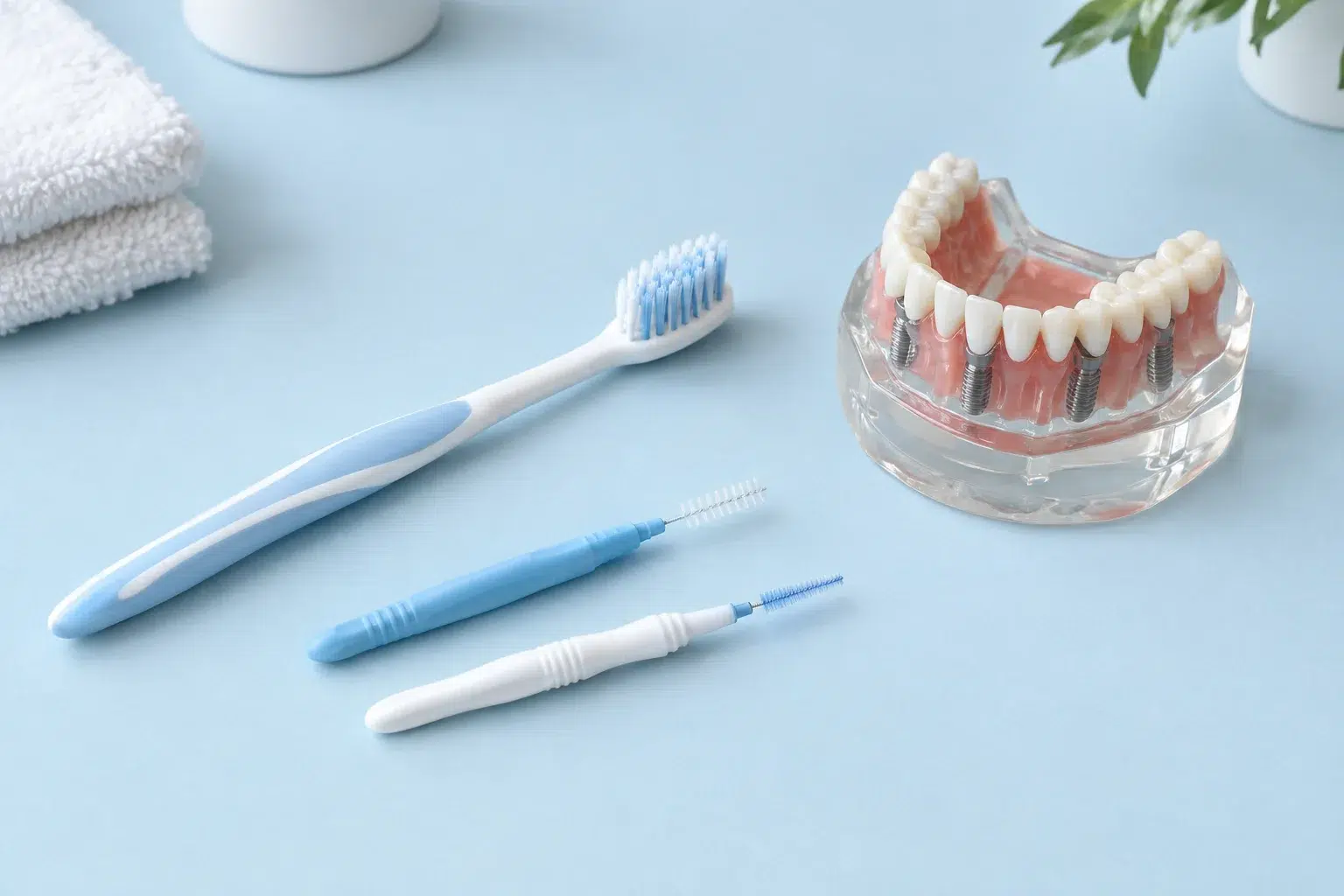
Cleaning has to reach the areas under the bridge and around the points where the implants emerge. Ask to be shown the right accessories and check that you can genuinely use them. The shape of the prosthesis must allow this cleaning; your manual dexterity and your eyesight count in choosing the solution.
Prevention starts before placement and carries on afterwards. The EFP recommendations on peri-implant diseases place maintenance and monitoring within the continuity of treatment. How often check-ups are needed depends on your situation, rather than on a single schedule applied to everyone.
Repeated bleeding when you clean, a new bad smell or discomfort under the prosthesis are worth reporting. Even without pain, keep to the appointments planned. How comfortable you feel is not enough to judge the state of the bone around the implants.
Which price should you compare for a full jaw in Turkey?
A price per implant does not tell you the cost of a restored arch. Ask for a written quote covering the whole pathway, and making clear whether it covers one arch or two. It should state the examinations, extractions, implants, abutments, temporary prostheses, final prostheses and any bone procedures.

Add the spending linked to the stays: travel, accommodation, a companion if needed, changes to bookings and time off work. Ask whether check-ups, adjustments, early repairs and extra appointments are included. Two prices can only be compared if their scope is identical.
Guarantee terms should be clear and easy to read. A guarantee on a component does not necessarily cover the care, the travel or the accommodation needed to replace it. Have the exclusions, the documents required and the practitioner responsible for follow-up spelt out.
For any reimbursement, send the detailed quote to your health insurer and to any top-up cover before you commit. Obtain a written answer that matches your situation. A commercial estimate is not confirmation that you will be reimbursed.
Our guide to the dental implant lets you go back over the various components of the treatment. For a full arch, keep this as your benchmark: a plan you can explain simply, covering the teeth to keep or remove, the solution chosen, its stages, its total cost and the professionals who will look after it.
Arranging follow-up with a practitioner near you
Before the first departure, look for a professional willing to handle local check-ups and agree with them what they will be able to do. A suitable scale and polish, a clinical check, a repair and further surgery do not call for the same resources. This discussion tells you who to turn to, instead of discovering the arrangements at the moment something starts to bother you.
Ask the team treating you to send the operative report, the references of the components, the follow-up plan and any useful imaging. Check that you can obtain these in a format the practitioner who sees you can use. Also keep the quotes and the instructions given after each stage, so that changes to the plan remain understandable.
Clarify who does what: who answers a simple question, who can adjust the prosthesis and who should be contacted if a procedure becomes necessary. A contact you can reach is useful, but access to a local examination matters just as much. This preparation gives follow-up a concrete place in your budget and your diary, right from the start of the pathway.
Sources
U.S. Food and Drug Administration. (s. d.). Dental implants: What you should know. https://www.fda.gov/medical-devices/dental-devices/dental-implants-what-you-should-know
International Team for Implantology. (2018). Number of implants placed for complete-arch fixed prostheses. 6th ITI Consensus Conference. https://network.iti.org/academy/consensus-database/consensus-statement/-/consensus/number-of-implants-placed-for-complete-arch-fixed-prostheses/1701?recFrom=10801&recFromId=1817
International Team for Implantology. (2013). Loading protocols for fixed prostheses in edentulous jaws. 5th ITI Consensus Conference. https://academy.iti.org/academy/consensus-database/consensus-statement/-/consensus/loading-protocols-for-fixed-prostheses-in-edentulous-jaws/1313?recFrom=10801&recFromId=1311
Kavlekar, A. S. (2025, 18 février). Implant-supported overdentures: The unsung hero of full arch replacement. ITI Blog. https://blog.iti.org/clinical-insights/implant-supported-overdentures-the-unsung-hero-of-full-arch-replacement/
Leeds Teaching Hospitals NHS Trust. (2025, 4 juin). Dental implants. https://www.leedsth.nhs.uk/patients/resources/dental-implants/
Guy’s and St Thomas’ NHS Foundation Trust. (2024, décembre). Dental implants: Overview. https://www.guysandstthomas.nhs.uk/health-information/dental-implants
European Federation of Periodontology. (s. d.). Peri-implant diseases. https://www.efp.org/for-patients/dental-implants/peri-implant-diseases/
European Federation of Periodontology. (2023). Guideline on treatment of peri-implant diseases. https://www.efp.org/education/continuing-education/clinical-guidelines/guideline-on-treatment-of-peri-implant-diseases/