

Our accreditations

Otoplasty in Istanbul: reshaping prominent ears
Up to 70% savings
Experienced surgeons in Istanbul
English-speaking support from start to finish
12 months of post-operative follow-up

They're talking about us


Your journey in Istanbul
First consultation, online or on site
You send photos from the front, the side and three-quarters, with your ears clear of your hair. A video call then pins down what bothers you: too wide an angle, a flat antihelix, an asymmetry.
Arranging your stay and the pre-operative checks
A VIP transfer takes you from the airport to the 5-star hotel, then to the clinic for the pre-operative work-up: blood test, anaesthetic consultation and medical photographs. The surgeon then goes back over the plan with you.
Surgery at our partner clinic in Istanbul
The anaesthetic chosen to suit your age is confirmed that morning. The surgeon cuts in the crease behind the ear, reshapes the cartilage and applies a compression dressing, before a VIP transfer takes you back to the hotel.
Post-operative follow-up, then the journey home
You are seen again on site and the first dressing is changed after two or three days, with written aftercare instructions in English. Once you are back home, your follow-up carries on for 12 months.

Take stock before you decide
Ask for your free quote for otoplasty in Istanbul, sent within 24 hours, with no obligation.
Body Expert Istanbul: your reference clinic
A partner clinic, not an intermediary | Body Expert directs you to its partner clinic in Istanbul, selected for its technical facilities and the experience of its surgeons. You pay the clinic rate, with no agency surcharge.

Personalized consultations
Our surgeons assess your situation in detail and define a treatment plan tailored to your goals. A conversation in French, in complete confidentiality.

Personalized consultations
Our surgeons assess your situation in detail and define a treatment plan tailored to your goals. A conversation in French, in complete confidentiality.

On-site procedure
Your procedure takes place directly at our partner clinic in Istanbul. You benefit from our surgeons' expertise and comprehensive medical supervision.
Why trust Body Expert?


Send your photos, get an opinion
Send photos with your ears clear of your hair and get a first surgical opinion and your free quote within 24 hours.
FAQ
How long do I need to stay in Istanbul for otoplasty?
How long you stay is settled with the medical team. Allow at least the first few days on site, the time it takes for the check, the first dressing change and the surgeon’s go-ahead to fly. Your hotel nights with breakfast and your VIP transfers are arranged, while you book your own flight. The exact number of nights depends on the operation and appears on your quote.
Is otoplasty painful?
During surgery, the anaesthetic used, local, deep local or general, keeps you comfortable. In the days that follow, most patients describe tightness and tingling rather than sharp pain, and painkillers are prescribed. Swelling and bruising can last around two weeks. At night, lying on your back with the headband on is what eases that tightness best.
From what age can the operation be done?
Ear cartilage is usually mature enough at around seven, and surgery is rarely offered before that age. In a child, motivation counts as much as anatomy, because the request has to come from them. In an adult, no age limit applies as long as general health allows, even if partial recurrence is a little more common.
What does the Body Expert package cover?
Your stay is built around a 5-star hotel with breakfast, VIP transfers between the airport, the hotel and the clinic, a dedicated English-speaking coordinator and 12 months of post-operative follow-up. Your quote reaches you free of charge within 24 hours, with no obligation. Your plane ticket stays yours: you book the flight, then the team takes care of your arrival.
What are the risks, in practice?
A review of 28 studies (3493 patients) puts haematoma or bleeding at 2.5%, infection at 0.8%, healing problems at 3%, troublesome scars at 1.6%, pain and itching at 13%, revision or recurrence at 5% (Sadhra et al., 2017). A second synthesis (18 studies, 1590 patients) records suture extrusion in 5.4%, recurrence in 2.8% and further surgery in 2.1% (Kaleeny and Janis, 2026). The 12 months of follow-up are there to pick up anything unusual.
What happens on the day of the operation?
The type of anaesthetic chosen for your age is confirmed that same morning: local, deep local or general. The surgeon cuts in the natural crease behind the ear, lifts the skin, then sculpts the cartilage by scoring before holding it with permanent stitches, sometimes with a conchal resection. A bandage then keeps the new shape in place. The operation often runs 45 minutes to an hour and a half.
When do work and sport start again, and how long is the headband worn?
Work or school often starts again after a week, gentle exercise after three to four weeks, and contact sports nearer two months. Once the first dressing comes off at day 2 or day 3, the headband is worn two weeks day and night, then at night for a month. You avoid lying on the ear and keep your ears out of cold wind and sun for two months.
How do I get a first opinion on my ears?
You send photos from the front, the side and three-quarters, ears clear of your hair and with no retouching, then a video call pins down what bothers you. The surgeon tells you whether your cartilage is suited to the operation, or whether it is better to wait in the case of a child. Your quote reaches you free of charge within 24 hours, with no obligation.
What otoplasty corrects
-
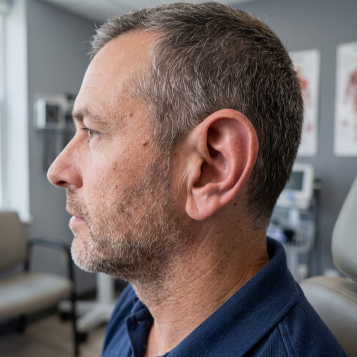 An oversized concha
The bowl of the ear, when it is too deep, pushes the ear forwards. Taking away part of that cartilage reduces the projection and brings the ear back towards the head.
-
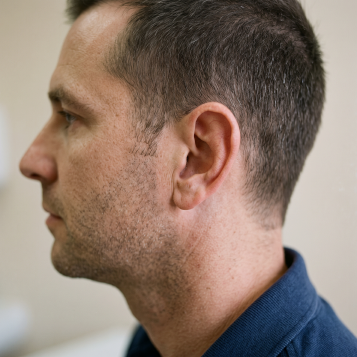 A flat antihelix
The inner fold that should break the curve of the ear sometimes has too little relief. The surgeon gives it its shape back, so the ear folds in towards the head.
-
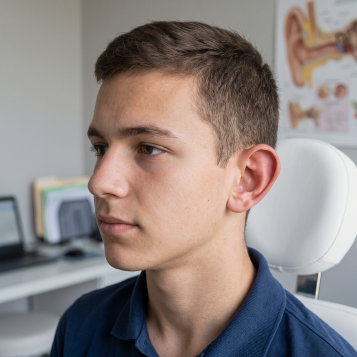 A protruding lobe
The lower part of the ear sometimes sticks out on its own, sometimes on top of a conchal bowl that sits too high. The correction then takes in the base and the rest of the ear together.
-
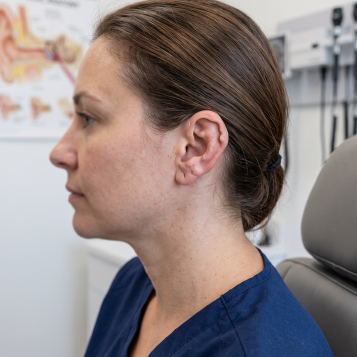 Asymmetry or an old injury
A marked difference between the two ears, or a deformity left by an old injury, also falls to this surgery. Whether to operate is judged on the anatomy and on realistic expectations.


Techniques
-
 Incisions in the crease
The surgeon works through the natural crease behind the ear, then lifts the skin to reach the cartilage. A short line on the front of the ear is added only if the operative plan calls for it.
-
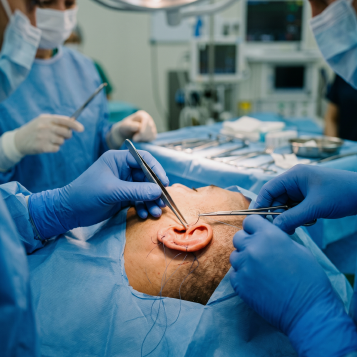 Scoring the cartilage
The cartilage is first softened by scoring, so that it takes a new fold. This step decides how well the reshaping holds over the months that follow.
-
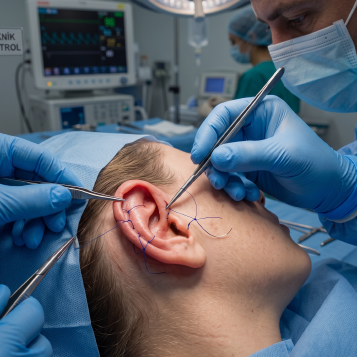 Permanent sutures
Permanent stitches then hold the shape that has been created. Protocols that pair sutures with scoring, or scoring with a flap, give fewer recurrences and fewer reoperations than a single technique.
-
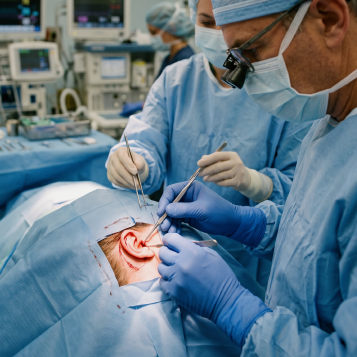 Conchal resection
When the concha sits too high, the surgeon adds a partial resection. The choice is made case by case, from the relief of your ear and how supple your cartilage is. The skin is usually closed with dissolvable stitches, before the bandage goes on.


Discussing your project

What is otoplasty?
Otoplasty is the surgery that corrects ears sitting too far from the head. The surgeon repositions and reshapes the pinna so that it sits well with the face: it is brought closer to the head and a fold that never formed is rebuilt, aiming for a result that looks right rather than two ears identical to the millimetre. What weighs on people day to day has less to do with the gap itself than with the constant reflex of hiding their ears.
A handful of anatomical patterns come up again and again, often together. Overgrown cartilage in the concha, the bowl of the ear, pushes it forwards. An antihelix that has not folded properly, the inner ridge that should break the curve, leaves the ear open for want of relief. A protruding lobe shifts the lower part, and too wide an angle between ear and head widens the whole thing further. These four situations are the usual indications for otoplasty, on their own or combined.
Prominent ears and other deformities of the pinna affect 5 to 10% of the population (Kaleeny and Janis, 2026). The operation is a common one, which does not stop each case being discussed on its own terms, from your photos and the real shape of your ears.
Otoplasty has been performed since the nineteenth century and turned a corner in the 1960s, when plastic surgery learnt to sculpt cartilage instead of simply pinning it back against the skull. Reshaping techniques have multiplied since, to the point where more than 200 are now described. Across 22 studies, methods that pair sutures with cartilage scoring, that is thinning it so it will bend, or scoring with a flap, give fewer recurrences and fewer reoperations than approaches built on one technique alone (Thomson, Gosden and Mandal, 2026). Your surgeon settles on a method according to your anatomy, how supple your cartilage is and the defect to be corrected. For the medical side of the operation, its techniques and its aftermath in detail, the otoplasty guide covers the ground.
Non-surgical options exist, based on devices that try to bend cartilage while it is still soft, sometimes with metal springs. On an ear that has already set, in an adult above all, only surgery changes the shape for good. 3D modelling and finer instruments have sharpened the planning stage.

How much does otoplasty in Istanbul cost?
At Body Expert, the consultation, the operation and the post-operative check all happen in Istanbul, in the same place and with the same team. Your stay is built around a 5-star hotel, VIP transfers, an English-speaking coordinator and 12 months of follow-up, for a budget that can mean up to 70% savings compared with the UK.
The package brings together everything around the operation: your hotel nights and breakfasts, the journeys, the interpreting and the follow-up. You book your own flight. Your quote reaches you free of charge within 24 hours, with no obligation, and sets out the number of nights that matches your operation.

Who is otoplasty for?
The most frequent candidates are a child over seven, whose cartilage has grown enough, a teenager on the receiving end of comments at school, or an adult tired of hiding their ears under their hair. It is around that age that cartilage has developed far enough for reshaping to hold.
Marked asymmetry, an old injury or an over-projecting lobe also fall to this surgery, because the decision rests on anatomy far more than on age. The right candidate is someone whose ear shape matches what the operation can correct and whose expectations stay realistic, symmetry down to the millimetre being something no surgeon can aim for. In a child, their own wish to go ahead is decisive: it weighs on the decision as much as the family’s view.

Contraindications
Several situations push the operation back or rule it out, among them uncontrolled clotting disorders, an autoimmune condition that gets in the way of healing, an active ear infection or poorly managed diabetes. Smoking comes with a rule of its own, since stopping at least a month before surgery is generally asked for and governs when the date can be set. Expectations that are out of proportion, such as perfect symmetry or a change in how other people behave, are talked through at the consultation before a date is agreed.

Preparing for surgery
The pre-operative tests you need
The pre-operative work-up covers a blood test, an anaesthetic consultation and medical photographs taken from several angles. If you are still at home, the process starts with your photos and a video call; if you are already in Istanbul, the first meeting can take place at the clinic. On arrival, the surgeon goes back over the operative plan with you, which leaves time to raise anything left hanging since the video call and to set the date knowing where you stand.
What to do before the operation
Aspirin and anti-inflammatories stop ten days before surgery, unless the doctor who prescribed them says otherwise, and smoking at least a month before. The night before and again on the morning itself, you wash your hair with an antiseptic shampoo, and a fast of about six hours is asked for when the type of anaesthetic calls for it. You turn up with your hair pinned back and your ears clear. Your English-speaking coordinator passes on each of these instructions and checks with you that they are clear.
The operation, step by step
Anaesthetic
The choice between local, deep local and general anaesthetic depends on your age, your anxiety, how long the operation is expected to take and what was agreed at the consultation. Whichever is used, it is set up for your comfort during surgery.
Incisions
The incisions run in the natural crease behind the ear. A short extra line on the front of the ear is added only when the operative plan calls for it.

Reshaping the cartilage
Once the skin is lifted, the surgeon reaches the cartilage and works in two stages: it is first weakened by scoring, so that it accepts a new fold, then that shape is held with permanent stitches. A partial resection is added when the concha sits too high. Depending on your anatomy, sutures are paired with scoring, or scoring with a flap, rather than one technique on its own.
Stitches and dressings
The skin is usually closed with dissolvable stitches, then a compression dressing wraps around the head to hold the ears in their new position.
How long the operation takes
The operation often runs 45 minutes to an hour and a half, depending on whether one ear or both are treated and on how complex the reshaping is. Your English-speaking coordinator translates and goes back over what is said, walks with you to theatre and is there when you wake up, before VIP transfers take you back to the 5-star hotel.

Recovery and aftercare
Your stay in Istanbul after surgery
How long you stay is settled with the medical team, knowing that the first few days are necessarily spent on site: the first dressing is changed at day 2 or day 3, so after two or three days, and the surgeon gives the go-ahead before you travel home. That timetable sets the total length of your stay, which appears on your quote. You are operated on in our partner clinic in Istanbul, selected for its facilities and its surgeons’ experience, where dedicated theatres, sterilisation routines and the checks done beforehand count as much as the work on the cartilage itself.
Pain and discomfort
The first few days bring moderate pain, tingling and a feeling of tightness, and painkillers are prescribed for them. Swelling and bruising generally settle by around two weeks. At night, keeping the headband on and lying on your back gives the clearest relief.

Aftercare and precautions
The compression headband is worn two weeks day and night, then at night only for a month, avoiding sleeping on your side. As soon as the bulky dressing comes off, a mild shampoo is fine again. Your ears stay protected from the sun and the cold for two months, and all of these instructions are given to you in writing, in English.
Recovery time and getting back to normal
Going back to work or school usually happens around a week in, once the visible marks are manageable. Light exercise starts again after three to four weeks, contact sports nearer two months. The final shape is not something to judge in the first week: allow one to two months for the swelling to go and the result to settle.
Across 18 studies (1590 patients, 3060 ears), the mastoid-helix distance, measured between the bone behind the ear and the rim of the pinna, drops on average from 27.1 mm to 15.4 mm after otoplasty, over a mean follow-up of 24.5 months (Kaleeny and Janis, 2026). These figures are averages from published series: they give a sense of how much repositioning is achieved when the indication is right, without saying what your own anatomy will allow.

Risks and possible complications
The possible complications are those of any surgery on the pinna. An infection is treated with antibiotics, while a haematoma may, if it is large, mean going back to theatre. Skin necrosis is more common in smokers, and hypertrophic or keloid scars are seen more often on darker skin. Add to that a partial recurrence, slightly more frequent in adults, and unusual sensitivity of the ear, temporary as a rule.
A review of 28 studies (3493 patients) puts haematoma or bleeding at 2.5%, infection at 0.8%, healing problems at 3%, troublesome scars at 1.6%, pain and itching at 13%, and revisions or recurrences at 5% (Sadhra et al., 2017). Another synthesis (18 studies, 1590 patients) finds suture extrusion the most frequent complication (5.4%), ahead of recurrence (2.8%) and further surgery (2.1%) (Kaleeny and Janis, 2026). What makes the difference is patient selection, sticking to the protocol and regular follow-up. Body Expert runs that follow-up for 12 months, from clear photos, video calls and instructions given in English, so that anything out of the ordinary is picked up early.

Why have your ears operated on in Istanbul
Istanbul has carried a heavy surgical workload for a long time, and the surgeons practising there see a wide range of ears, skin types and requests, in children as well as adults. You get a package set out in advance and a price gap that can reach 70% savings.
Body Expert works as a direct clinic, with more than 50000 procedures carried out, surgeons on site and English-speaking support running from your first message to the twelfth month. Your first consultation can be held remotely, then the whole surgical journey takes place in Istanbul, and you come home with a written care plan.
The same setup, seen at country level, is covered on the otoplasty in Turkey page. Istanbul is around a four hour flight from London, with direct services from several major European cities. You book the ticket yourself, and the team arranges your welcome at the airport.
Sources
- Sadhra, S. S., Motahariasl, S., & Hardwicke, J. T. (2017). Complications after prominent ear correction: A systematic review of the literature. Journal of Plastic, Reconstructive & Aesthetic Surgery, 70(8), 1083-1090.
- Kaleeny, J. D., & Janis, J. E. (2026). Otoplasty Surgical Techniques and Clinical Outcomes: A Practical Review. Plastic and Reconstructive Surgery Global Open, 14(1), e7404.
- Thomson, H., Gosden, J., & Mandal, A. (2026). Otoplasty for prominent ear: A systematic review of surgical techniques. JPRAS Open, 49, 221-233.