Otoplasty: correcting prominent ears
Otoplasty is a cosmetic operation that reshapes the ears, correcting their shape, size and position. It brings prominent or protruding ears back towards the head for a more balanced face.
Otoplasty at a glance

Prominent or protruding ears can weigh on your confidence, sometimes right from childhood: the teasing at school, the awkwardness in photos, that habit of hiding your ears under your hair. It’s a hang-up as common as it is quietly carried, affecting around 5% of people.

The good news is that otoplasty puts the shape and position of the ears right for good. This facial procedure reshapes the cartilage of the ear (the pinna, the visible part) to give a natural, symmetrical curve, with a scar hidden behind the ear. In Istanbul, experienced surgeons carry it out in our partner clinic, selected for its facilities, with English-speaking support from your first message through to follow-up, and up to 70% savings compared with the UK. To start planning, take a look at otoplasty in Turkey too.
From consultation to the final result
Your surgeon examines your ears, talks through what you’re hoping for and picks the technique best suited to you. Photos are taken and the operation is planned around your personal and work commitments.
Otoplasty is done under local or general anaesthetic. The surgeon makes a discreet incision in the crease behind the ear, reshapes the cartilage with stitches and/or by remodelling it, then closes the skin. Skin stitches, often dissolvable, are dealt with at your follow-up. Allow around 45 minutes to an hour per ear.
You wear a dressing, then a supportive headband, for a week. Any pain is mild and settles with ordinary painkillers. Swelling and bruising fade over ten to fifteen days.
You already see the new position when the dressing comes off, and the look settles as healing finishes. Wearing a headband at night is advised for a month, with remote follow-up handled by our team.

Thinking about otoplasty? Let’s talk
Our English-speaking medical advisers will send you a free, personalised quote within 24 hours.
Otoplasty techniques
-
 Mustardé technique
Permanent sutures recreate the fold of the antihelix without removing any cartilage. Known for holding up well over time and for being minimally invasive.
-
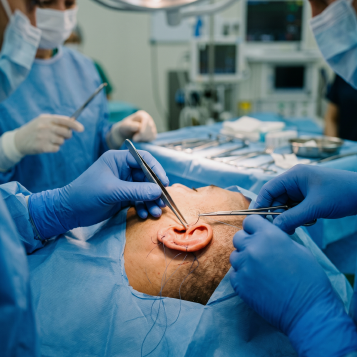 Furnas technique
Concho-mastoid sutures draw the concha closer to the skull. Well suited to correcting an over-deep concha, on its own or alongside other approaches.
-
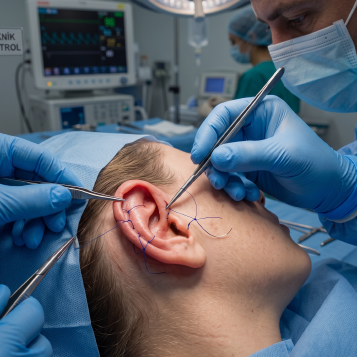 Stenström technique
Reshaping the cartilage of the antihelix by scoring its front surface, to soften it and let it curve naturally.
-
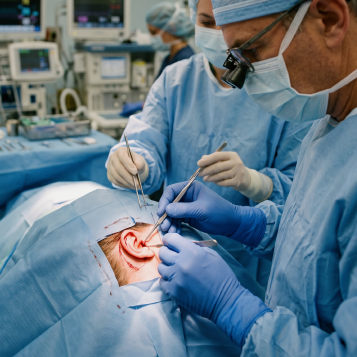 Chongchet technique
A cut behind the ear exposes the cartilage, whose front surface is then sculpted under direct view to shape an even fold.


Ready to take the plunge?
Talk to our English-speaking advisers and get a treatment plan shaped around your ears.
Common questions about otoplasty
At what age can prominent ears be corrected?
Otoplasty can be carried out from the age of 7, once the ear cartilage is close to adult size and the child asks for it themselves. Operating early limits the sting of teasing.
Is otoplasty painful?
Otoplasty causes little pain. Most people feel no more than some discomfort in the first few days, soon eased by ordinary painkillers.
How long does the operation take?
Allow 1.5 to 2 hours to correct both ears, as a day case, with you going home the same day.
Local or general anaesthetic?
The choice between local and general anaesthetic is made at your consultation, based on your age and what you’d prefer.
Will the scar show?
The incision is tucked into the crease behind the ear, so the scar is all but invisible.
When can I go back to work and sport?
Everyday activities often pick up again within 2 to 3 days. Time off work is usually about a week, while the headband is on. Contact sports are best avoided for 6 weeks.
Are the results permanent?
The correction is lasting. You’ll see the final look properly after two to six months, once the swelling has gone.
Can just one ear be operated on?
Where there’s asymmetry, the surgeon can correct a single side to bring the face back into balance.
Can an uneven otoplasty be put right?
A revision can correct any asymmetry or partial relapse. Flag anything that looks off to your surgeon.
Can otoplasty be combined with another operation?
Yes, it pairs well with other facial work, such as a blepharoplasty or thread lift. A chin surgery can also be considered to balance the profile.
Why have your otoplasty in Istanbul?
You get experienced surgeons at our partner clinic in Istanbul, selected for its facilities, full English-speaking support and up to 70% savings compared with the UK.
Let’s discuss your project

Understanding otoplasty
Otoplasty, or surgery for prominent ears, is a facial cosmetic operation that corrects the shape, size and position of the ears. It’s for anyone bothered by protruding, uneven or misshapen ears, whether that’s a child self-conscious about teasing or an adult after better facial balance. The principle is simple: reshape the cartilage of the ear (the pinna, the visible part) to bring the ear closer to the head and rebuild its natural contours. Prominent ears are the most common congenital difference of the head and neck, affecting around 5% of people, usually running in the family.

Why do ears stick out?
A prominent ear usually comes down to a mix of three anatomical features, present from birth and unlikely to sort themselves out. The main ones are these:
- An underdeveloped antihelix fold: the Y-shaped ridge inside the ear hasn’t formed properly, so the ear can’t fold back towards the head.
- An oversized concha: the central bowl of the ear is too deep or too large, pushing the ear forwards.
- Too open an angle between ear and skull: the angle goes beyond 30 degrees, which makes the ear look more prominent.
These features can appear on their own or together, in one ear or both. It’s the careful assessment at your consultation that sets the surgical plan best suited to you.

Who is otoplasty for?
Otoplasty can be carried out from the age of 7, once the ear cartilage has matured and the child wants the operation themselves. Done early, it heads off the psychological toll of teasing at school. In adults there’s no age limit: plenty of people finally decide to put right a hang-up they’ve carried since childhood. The operation is also used for reconstructive reasons, after an injury or to correct a malformation of the ear.

Surgical techniques for otoplasty
More than 200 otoplasty techniques have been described in the medical literature, a sign that no single method suits every ear. They fall into two broad, complementary families.

Suture techniques
These reshape the cartilage without removing any, using permanent stitches. The Mustardé technique recreates the fold of the antihelix with concha-to-scapha sutures and is still one of the most widely used, thanks to how well it holds up over time. The Furnas technique repositions the concha by drawing it closer to the mastoid bone, and is particularly useful when the bowl of the ear is overdeveloped.

Cartilage-remodelling techniques
These work by softening the cartilage so it curves for the long term. The Stenström technique thins the front of the antihelix by scoring it, while the Chongchet technique sculpts the cartilage under direct view. The surgeon chooses, or combines, these approaches according to your anatomy and their own experience. For overall facial balance, otoplasty can sit alongside other operations such as blepharoplasty, rhinoplasty or a face lift.

How is the operation done?
Otoplasty is carried out as a day case, under local or general anaesthetic depending on your age and what you’d prefer. The surgeon makes a discreet incision in the crease behind the ear, which leaves the scar all but invisible once healing is done. The cartilage is then exposed, reshaped with stitches or by remodelling, and the skin closed. Skin stitches, often dissolvable, are dealt with at your follow-up. The operation takes around 45 minutes to an hour per ear. A lightly supportive dressing goes on at the end to hold the new shape.

Recovery and aftercare
Recovery from otoplasty is usually straightforward and causes little pain. You wear a dressing, then a headband, for a week, which is often about how long you’ll want off work. Some swelling and light bruising can linger for ten to fifteen days before fading. Everyday activities pick up again in two to three days, while contact sports and long soaks in water are best left for six weeks. Wearing a headband at night is worth keeping up for a month, to protect the ears in their new position.

Results and satisfaction
Otoplasty gives an immediate, visible correction, with the final look settling once healing is complete, some two to six months later. Satisfaction tends to be high. Beyond the aesthetics, the operation carries a real psychological weight: getting back even, natural-looking ears restores self-esteem and confidence, especially for those who were teased as children. That’s what puts otoplasty among the most rewarding facial operations, alongside genioplasty or canthopexy. The result is stable over time, and a second operation is only needed in the rare cases of leftover asymmetry or partial relapse.

Risks and complications of otoplasty
In the hands of an experienced surgeon, otoplasty is a safe operation, but like any surgery it carries risks worth knowing. At the first sign of anything unusual, tell your surgeon straight away. The main possible complications are these:
- Haematoma: usually prevented by the supportive dressing applied after surgery.
- Infection: very rare, thanks to strict sterile technique and preventive antibiotics.
- Skin necrosis: very uncommon, linked to sutures pulled too tight.
- Raised or keloid scars: infrequent, managed with massage and compression.
- Asymmetry or relapse: may call for a small revision in rare cases.
- – Changes in feeling in the ear: usually temporary, settling over the following months.
- Risks tied to general anaesthetic: minimal, and weighed up at the pre-anaesthetic consultation.

Why have your otoplasty in Istanbul?
Choosing Istanbul means expert surgeons working in our partner clinic, selected for its facilities, full English-speaking support and savings of up to 70% compared with the UK, with no compromise on quality or safety. You can also pair your stay with other facial treatments, such as buccal fat removal, or go for local, in-depth care set out on our page devoted to otoplasty in Istanbul. Well informed and well looked after by our team at every step, you approach your operation calmly and with realistic expectations.
In summary
Otoplasty is still one of the most polished facial operations: by reshaping the cartilage, it sets prominent or protruding ears back for good and gives the face its balance again. It’s all done as a day case, under local or general anaesthetic, through an incision hidden behind the ear that leaves no visible scar.
On recovery, count on a week or so in a headband, two to three days before heading back to work, and a result that settles between the second and sixth month. The operation suits children, from age 7, as much as adults, with no upper age limit. The surgeon picks the technique best matched to your anatomy, from the Mustardé method to cartilage remodelling.
In Istanbul, you’re operated on by experienced surgeons in our partner clinic, selected for its facilities, supported in English at every step, for even, natural ears and up to 70% savings compared with the UK. A single ear to correct, a revision after a first otoplasty, a procedure combined with other facial surgery: every case deserves a plan of its own.
Want to see your situation clearly? Ask for your free, personalised quote within 24 hours. Our English-speaking medical advisers get back to you and organise everything, from your first message through to aftercare.
Sources and references
- Kaleeny, J. D., & Janis, J. E. (2026). Otoplasty surgical techniques and clinical outcomes: A practical review. Plastic and Reconstructive Surgery Global Open, 14(1), e7404. Lien: https://pubmed.ncbi.nlm.nih.gov/41567352/
- Thomson, H., Gosden, J., & Mandal, A. (2026). Otoplasty for prominent ear: A systematic review of surgical techniques. JPRAS Open, 49, 221-233. Lien: https://pmc.ncbi.nlm.nih.gov/articles/PMC12996986/JPRAS Open, 49, 221-233. Lien: https://pmc.ncbi.nlm.nih.gov/articles/PMC12996986/
- Madaras, T., et al. (2026). Objective auricular measurements and patient satisfaction following cartilage-cutting otoplasty using fascioperichondrial flaps. Journal of Clinical Medicine, 15(10), 3795. Lien: https://doi.org/10.3390/jcm15103795
- Jones, E. S., Gibson, J. A. G., Dobbs, T. D., & Whitaker, I. S. (2020). The psychological, social and educational impact of prominent ears: A systematic review. Journal of Plastic, Reconstructive & Aesthetic Surgery, 73(12), 2111-2120. Lien: https://doi.org/10.1016/j.bjps.2020.05.075
OUR ARTICLES ON Cosmetic surgery
-

-
-

-

-
 Breast enhancement and dental crowns in Istanbul: Marie and Océanie tell their story on RTL TVI
 -

-

-