

Sinus lift in Turkey: preparing the upper jaw for an implant
Sinus lift prior to implant placement.
Lateral or crestal approach, depending on your anatomy.
Savings of up to 70% compared to France.
Dedicated English-speaking assistant from start to finish.



Sinus lift in Turkey: raising the floor to make room for an implant
The maxillary sinus is an air-filled cavity hollowed out inside the bone of the upper jaw, above the premolars and molars. When a back tooth is lost, the bone that held it resorbs, while the sinus tends to expand into the space left free. Too little height then remains to anchor a dental implant properly. A sinus lift, or sinus floor elevation, rebuilds that space: the surgeon raises the membrane lining the sinus, then grafts the volume this opens up so that an implant can integrate into it.

Body Expert sets this procedure inside an implant plan organised in Istanbul, with the stay that goes around it: 5-star hotel (nights and breakfast), VIP transfers, a dedicated English-speaking patient coordinator, 12 months of post-operative follow-up, a free quote within 24 hours with no obligation, and up to 70% savings. Your flight stays yours to book.
What sinus floor elevation is trying to achieve
An implant needs bone around it to fuse, and then to carry a tooth. At the back of the upper jaw, that requirement runs into an awkward anatomy: the sinus is separated from the bony ridge by a thin wall and by a membrane, the Schneiderian membrane. Once the bone height under that wall drops too low, screwing in an implant would mean encroaching on the sinus cavity. Floor elevation creates a space under the membrane that bone, or a bone substitute, can occupy. The graft holds the membrane up while the site consolidates, and the implant is then anchored in the height that has been rebuilt.

That reconstruction opens up tooth replacement at the back of the upper arch, where the molars do most of the chewing. Without enough height, an implant in the posterior maxilla stays off the table or gets postponed. Once the floor is raised, the site works with a screw again, within the dental care Body Expert organises in Turkey. Getting molar support back also takes load off the remaining teeth, once the implant is in function.
The indication rests on imaging and on clinical examination. The surgeon weighs the remaining height, the state of the membrane, any sinus infection, the number of sites to rebuild and where this procedure sits in the wider plan. A single molar site and a broader reconstruction are not the same conversation: the first can work with a localised approach, the second usually calls for a wider view of the wall. The graft material chosen and the timetable belong to that same individual reasoning, which you then find item by item on your written quote, before anything is booked.
Lateral or crestal approach: what the comparison establishes
There are two ways to reach the sinus floor. The direct approach, also called lateral, opens a window in the outer wall of the maxilla, lifts the membrane under direct vision and grafts the site from that side. The indirect or crestal approach goes through the ridge, at the point where the implant is planned, and raises the membrane from below. The clinical question is which of the two fits the file being read.

Shah, Chauhan and Shah pooled 17 studies in a meta-analysis of implant survival after sinus lift. They found no statistically significant difference in implant survival between the direct (lateral) and the indirect (crestal) approach; the choice of technique depends on the case. Those data move the discussion towards the fit between the anatomy observed and the approach taken, since the technical family on its own does not separate the results obtained in this body of work.
The operative differences are real enough. The lateral approach gives a wider view of the membrane and suits larger reconstructions, while the crestal one stays local, centred on the channel where the screw will go. Height thresholds, graft materials and the delay between elevation and implant placement belong to the individual plan, which the surgeon settles after reading the full file. The meta-analysis answers the question of comparative survival by route; the detailed operative conduct belongs to whoever is operating on this particular jaw, with the imaging in front of them.
For you, that equivalence has a practical consequence. A plan that proposes one route rather than the other should argue it from your anatomy, remaining height, extent of the site, state of the membrane, rather than from a preference of principle. That is exactly what the written opinion from our surgeons sets out before you travel, and what lets you hold it up against a second opinion.
What happens to the implant when the membrane tears
During a lateral-approach sinus lift, the membrane can tear. Díaz-Olivares and colleagues reviewed how perforations of the Schneiderian membrane are managed during lateral sinus floor augmentation. Their meta-analysis covers 1598 sinus lifts and 3604 implants. Perforation occurs in 30.6% of cases. Repaired properly with a collagen membrane, it does not compromise implant survival: 97.68% under a repaired membrane against 98.88% under an intact one.

The value of this work lies first in what it puts a number on. Giving the incident a frequency places it among the expected events of the lateral approach, something the surgeon anticipates while lifting and knows how to close when it happens. The second lesson concerns what follows: after repair with a collagen membrane, implant survival sits right next to what is seen under an intact membrane, across more than three thousand screws.
In practice, a perforation appears in the operative report when it has occurred, along with how it was closed. You leave with that information in hand, and the follow-up picks it up. If sinus discomfort, discharge or pain went beyond the picture explained to you before departure, your dedicated coordinator puts the question to the surgeon in English, without waiting for the next appointment.
How long the implant lasts once the site is rebuilt
Howe, Keys and Richards published a meta-analysis of 18 prospective studies on dental implant survival at 10 years. The rate comes out at 96.4% (95% CI 95.2 to 97.5). A sensitivity analysis accounting for patients lost to follow-up gives 93.2%. The risk of losing an implant is possibly doubled after the age of 65.

Two points make those figures readable. A prospective study enrols its patients before following them, which produces a fuller record than a review of old case notes; putting eighteen such follow-ups together gives a steadier order of magnitude than one isolated series. Patients lost to follow-up are those who dropped out before the end: bringing them back into the calculation lowers the rate, so that second figure measures survival while counting the people who never came back for a check.
These studies cover dental implants followed for a decade, grafted sinus or not. They give the horizon that sinus elevation works towards: rebuilding enough bone for a screw to then fall inside those survival figures. Age appears there as a possible risk factor, to be set against the other elements of your general health that the surgeon goes through with you on your own file.
How a sinus lift in Turkey is organised
The sinus lift, and the implant placement that goes with it where relevant, take place in Istanbul at our partner clinic, and Body Expert builds the stay around those appointments. The 5-star hotel covers the nights and breakfast. VIP transfers link the airport, the hotel and the clinic, on arrival and for consultations. A dedicated English-speaking patient coordinator remains your point of contact: she translates in the chair, goes back over the instructions and passes your questions to the surgeon. Post-operative follow-up continues for 12 months after the operation, through that same English-speaking channel once you are home.

The first useful document is the written quote, free within 24 hours and with no obligation. You send your dental situation and whatever images you have; the reply says whether a sinus lift belongs in the plan, which route the surgeon would take, and how the procedure fits with the implant. You then have a reasoned plan to compare with what you have been offered elsewhere, before buying a ticket. The parts of the stay, hotel, transfers and English-speaking support, appear alongside the procedure, so the total for the organised stay reads without having to be pieced together.
Sources
Shah, D., Chauhan, C., & Shah, R. (2022). Survival rate of dental implant placed using various maxillary sinus floor elevation techniques: A systematic review and meta-analysis. Journal of Indian Prosthodontic Society. https://pubmed.ncbi.nlm.nih.gov/36511050/
Díaz-Olivares, L. A., Cortés-Bretón Brinkmann, J., Martínez-Rodríguez, N., Martínez-González, J. M., et al. (2021). Management of Schneiderian membrane perforations during maxillary sinus floor augmentation with lateral approach: a systematic review and meta-analysis. International Journal of Implant Dentistry, 7. https://pubmed.ncbi.nlm.nih.gov/34250560/
Howe, M. S., Keys, W., & Richards, D. (2019). Long-term (10-year) dental implant survival: A systematic review and sensitivity meta-analysis. Journal of Dentistry, 84, 9-21. https://pubmed.ncbi.nlm.nih.gov/30904559/

Get a sinus lift quote for Turkey
Send us your dental situation and your X-rays: a free quote within 24 hours says whether sinus elevation belongs in the plan, with no obligation.
What the surgeon does at the back of the upper jaw
-
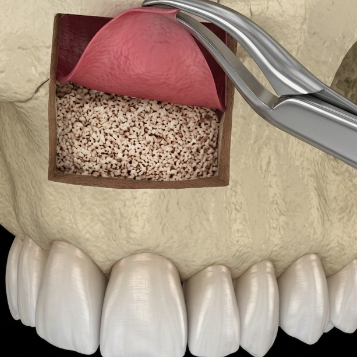 Lateral sinus approach
This route gives a direct view of the membrane throughout the lift. The surgeon takes it when the area to raise is large, or when several neighbouring sites need rebuilding.
-
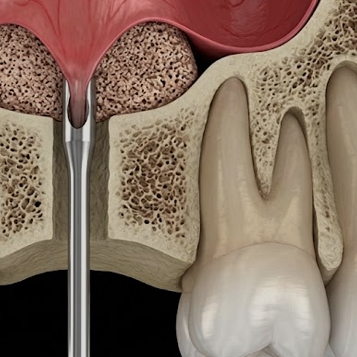 Crestal sinus approach
Access here is limited to the drill channel of the future implant, with no opening in the outer wall. The surgeon works from the ridge when the configuration read on the imaging allows it.
-
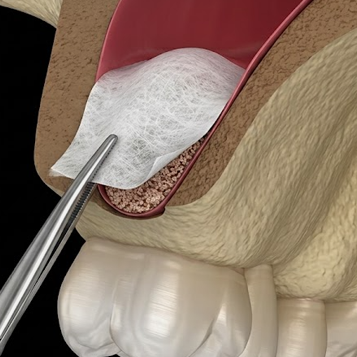 Collagen repair of the membrane
A tear spotted during the operation is closed with a collagen membrane in the same session. The report flags it, so that the follow-up knows what was treated.
-
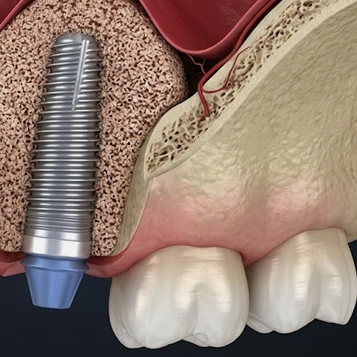 From graft to screw
On examination, the surgeon decides whether the implant can follow the elevation in one stage or whether two are needed. That sequence is settled before you travel, while it can still be changed.


Indications, assessment and how the stay is organised
A sinus lift comes up when you want an implant at the back of the upper jaw and the bone height under the sinus does not allow it as things stand. The indication grows out of a tooth replacement plan: missing molars, chewing pushed onto one side, neighbouring teeth starting to tip into the gap. As long as that height is missing, screwing in an artificial root would expose the sinus. Once the floor has been raised and the site grafted, the upper jaw becomes a possible support again.

Other situations push the indication back. Active sinusitis, disease of the membrane, smoking that has not been addressed, poor oral hygiene or a general condition that rules out oral surgery all mean treating the obstacle first. The surgeon at our partner clinic draws those lines from the images and from the clinical interview.
When sinus grafting is not the answer, other anchorages exist. Zygomatic implants suit some severely atrophied upper jaws, taking their support higher up, in the cheekbone. Turning down an elevation therefore leaves several implant options open, which the surgeon discusses from the same file; your written plan then separates what belongs to a sinus lift from what belongs to another anchorage, so that you compare two reasoned proposals rather than two memories of a conversation.
What the surgeon decides from your file
Before any dates are set, the file brings together whatever images you have and your medical history. The surgeon reads the height under the sinus, the number of sites involved, the state of the membrane and any other teeth needing treatment. He then says whether a lateral or a crestal approach fits the case, and whether the implant belongs in the same stage. An image that is not good enough leads to a request for more, always before the final quote. Where several molars are missing on the same side, the reasoning also covers the order of the sites: which to graft first, which can wait, which needs no elevation at all. That sequencing avoids treating the whole upper jaw in one go when the file does not call for it.

Your history counts as much as the picture. Smoking that is still active, a recent bout of sinusitis, a treatment that affects bone healing, hygiene that leaves plaque at the gum line: any of these can push the operation back or set conditions on it. Those reservations are written down alongside the surgical route, so that you reread a complete plan once you are back home.
This stage ends in the quote. Free within 24 hours and with no obligation, it puts the plan in writing: sinus lift or not, the route considered, how it links to the implant, what the stay contains. Up to 70% savings apply to that total, which brings together the procedure, the clinic and the logistics of the stay.
You can then check that the elevation being proposed really answers a shortage of height. If the surgeon judges the height already sufficient, the sinus lift drops out of the plan and the implant is discussed without that preliminary step. Nothing is booked until you confirm: the document can be read again with a clear head, shown to your own dentist, or simply left waiting for your decision.
That second reading matters all the more because an implant plan runs over several months. You can come back to the team with written questions about what the proposed graft actually covers, about what would happen if the surgeon changed the route after rereading the imaging on site, or about how the implant will fit into the rest of the treatment. Every answer reaches you in English, before a single date is fixed, and the plan is corrected whenever one of those points warrants it.
Your stay in Istanbul with Body Expert
Once the plan is accepted, Body Expert books the 5-star hotel (nights and breakfast) and the VIP transfers. Your dedicated English-speaking patient coordinator meets you, translates the exchanges in the chair and goes back over the instructions. You arrive on the flight you have booked yourself; everything on the ground is timed around the appointments at our partner clinic.

On site, the clinical examination goes back over the elements of the file. The surgeon confirms the route, performs the sinus lift and, where the plan calls for it, places or schedules the implant. The immediate aftermath is watched before you fly home: pain under control, hygiene instructions, the signs that should make you write to the team. The detailed timetable, time in the chair, number of nights, delay before any second stage, appears on your quote, because those things depend on the case.
The English-speaking coordinator is there at the appointments. She translates the questions you put to the surgeon and the answers that concern the membrane, the graft and what follows for the implant. You leave with written instructions, gone through in English, without having to get an operative report translated afterwards. That relay counts particularly where the membrane has been repaired, since the signs to watch for are then spelled out case by case.
Between appointments, the hotel is your base: the nights and breakfast are already booked. Transfers link the hotel, the airport and our partner clinic at the agreed times. The coordinator stays reachable and passes your requests to the practitioner in your own language, so that you never have to improvise clinical vocabulary. The same goes for instructions handed over between sessions, put back into plain words as often as needed until you know exactly what to watch for.
Follow-up once you are home
The 12-month post-operative follow-up takes over after the return. It is there to watch how the grafted site heals, how the implant holds where one was placed, and that no sinus symptoms persist. Exchanges happen in English, through the same channel as your dedicated coordinator. A photograph, or an X-ray taken by your own dentist, can feed into that remote check.

This channel fills the gap that often follows a return from abroad. The questions that come up once ordinary life resumes, an unusual sensation on the operated side, a doubt about what you can chew, what to do before seeing your own dentist, reach someone who already knows your file and the operative report. Your history stays available at every exchange, without you having to reconstruct it.
That year of follow-up covers the period when the graft and, where relevant, osseointegration of the screw consolidate. Routine care, scale and polish, fillings, the other arch, stays with your own dentist in the UK. If a second stay turns out to be needed for the rest of the plan, Body Expert reorganises the hotel, the transfers and the coordinator on the same basis, with an English-speaking channel already open.
Rebuilding that bone height has only one destination: the implant it makes possible, and chewing restored at the back of the upper arch. That is the result the stay in Istanbul is built around, from the first X-ray you send through to the twelfth month of follow-up.
Talk the plan through with an English-speaking adviser
A call in English covers whether a sinus lift is indicated, how the stay in Istanbul runs and the follow-up once you are back home.
FAQ
Why is a sinus lift sometimes needed before an implant?
The bone height available under the sinus, at the back of the upper jaw, sometimes falls below what anchoring a screw requires. Floor elevation then raises the Schneiderian membrane and grafts the space that opens up, until there is usable thickness again. Without that rebuilt height, the screw would be looking for its anchorage in an air-filled cavity, which the surgeon rules out.
How does the surgeon choose between a lateral and a crestal approach?
He reads the bone height, the extent of the site to rebuild and the state of the membrane, then takes the route that matches that file. A meta-analysis of 17 studies found no significant difference in implant survival between the two approaches: the decision therefore rests on your anatomy, and the reasoning is handed to you in writing before you travel.
What happens if the Schneiderian membrane tears?
In the literature on the lateral approach, this affects 30.6% of procedures. The surgeon closes the tear with a collagen membrane during the same session. Across 1598 sinus lifts and 3604 implants, survival under a repaired membrane reaches 97.68%, against 98.88% under an intact one. The incident appears in the operative report you take home.
Does an implant placed after a sinus lift last as long as a standard one?
Sinus elevation rebuilds the support; how the screw then holds is a matter of general implantology. At 10 years, a meta-analysis of 18 prospective studies puts survival at 96.4% (95% CI 95.2 to 97.5), and at 93.2% when patients lost to follow-up are brought back into the calculation. Those are the figures your plan rests on.
Does age change the discussion around an implant?
Howe and colleagues note a risk of implant loss possibly doubled after the age of 65. That factor enters the conversation alongside general health, smoking and day-to-day hygiene, without closing the indication on its own. The decision is made on the evidence, in Istanbul, and the free quote within 24 hours records that discussion, with no obligation.
What does Body Expert organise around the sinus lift?
The stay covers the 5-star hotel with nights and breakfast, VIP transfers, a dedicated English-speaking patient coordinator, then 12 months of post-operative follow-up. The whole plan, procedure included, is quoted within 24 hours and with no obligation, with up to 70% savings. Your plane ticket is bought on your side.
Should I have All-on-4 rather than a sinus lift?
The two answer different gaps. Sinus elevation rebuilds height under the sinus to take a screw at the back of the upper jaw, while All-on-4 restores a whole arch on four implants. Depending on how much of the arch is missing, the surgeon takes one, the other, or combines them, and your written plan keeps the two options apart.
How does follow-up work once I am back home?
For 12 months, exchanges carry on in English with your dedicated coordinator, who follows the healing of the grafted site and, where relevant, how the placed screw behaves. An X-ray taken at your own dental practice can feed into that remote check. For the local side of things, our page on dental implants in Istanbul covers the stay from the city’s point of view.
Discussing your project