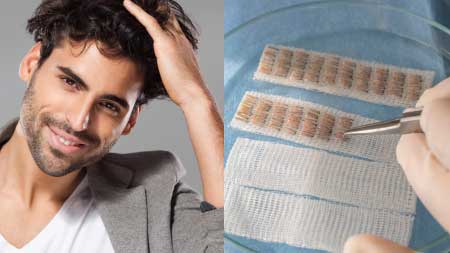
Female hair loss
Hair density
DHI
FUE
Natural results
Hair transplant for women
Hair loss in women is still talked about far too little. Yet fewer than 45% of women go through life with a full head of hair.Yet fewer than 45% of women go through life with a full head of hair. Our medical team helps you understand what causes female hair loss, which transplant techniques suit you best, and the results you can genuinely expect.
Women’s hair transplant at a glance
Hospital stay
Day case
Procedure duration
3 to 8 hours
Results visible after
12 to 18 months

Medical validation
Understanding hair loss in women

Nobody really talks about it, and that’s part of the problem. When a man loses his hair, it’s almost ordinary. People joke about it, shrug it off, get used to it in the end. When it’s a woman, the silence sets in. Because for a woman, hair is far more than a matter of looks. It’s part of who you are, of feeling feminine, of your confidence. Every strand that falls takes a little of that with it.
The numbers, though, leave no room for doubt. According to Dinh and Sinclair (2007), fewer than 45% of women go through life with a full head of hair, and the proportion of visible thinning climbs sharply after the menopause.According to Dinh and Sinclair (2007), fewer than 45% of women go through life with a full head of hair, and the proportion of visible thinning climbs sharply after the menopause. Figures that sit oddly against all that silence.
And the distress is real. Many women describe a drop in self-esteem, pulling away from others, sometimes a genuine slide into low mood. A lot of them feel, too, that their hair loss is less readily accepted than a man’s would be. It’s easy to see why looking for answers is entirely reasonable, and why a hair transplant in Turkey is increasingly the concrete, lasting one women turn to.
Female hair loss doesn’t look like male baldness

This is a fundamental thing to grasp. In men, baldness follows well-known patterns: the hairline recedes, the temples go back, the crown opens up. In women, the process is completely different. The frontal hairline usually holds, or moves only rarely. Fully bald patches are uncommon. The loss is diffuse, creeping, spread across the top of the head.Fully bald patches are uncommon. The loss is diffuse, creeping, spread across the top of the head. The central parting slowly widens, the hair grows finer, loses its body. It’s sometimes called the ‘Christmas tree’ pattern, typical of female androgenetic alopecia.
That diffuse quality makes it harder to diagnose, delays getting help, and leaves many women unsure for months, even years. Long enough to realise that no, it isn’t in their head: the hair really is thinning.
The many faces of female hair loss
Hair loss in women has plenty of causes, and that’s what makes every case its own. The commonest is androgenetic alopecia: inherited, tied to how genetically sensitive the follicles are to DHT (dihydrotestosterone). The follicles carry an inherited vulnerability to the combined action of testosterone and an enzyme called 5-alpha reductase, a sensitivity often expressed more clearly after fifty or so. The upshot: the hair cycle speeds up, regrowth comes back finer and finer, until it stops altogether.

Next come the hormonal upheavals: menopause, pregnancy, polycystic ovary syndrome (PCOS), coming off hormonal contraception. All of them turning points where the output of female hormones drops abruptly, leaving the field open to androgens. This is hormone-driven hair loss, the same androgenetic process already described.

Stress is a powerful trigger, and an underrated one. A sudden shock, a bereavement, an accident, a divorce, can set off telogen effluvium: two to three months later, an abnormal share of hairs shift into the shedding phase at oncetwo to three months later, an abnormal share of hairs shift into the shedding phase at once. The effect is dramatic and frightening, even if it usually reverses.

Traction alopecia, meanwhile, has risen noticeably over the past decade. Hair pulled tight, tight braids, repeated extensions, the daily strain of straighteners and hot dryers: the hairlines give way in the end, quite literally. The follicles, worn out from being tugged, stop producing. Add the chemicals on top, colouring, relaxers, hairspray, and the scalp simply hasn’t the reserves to keep up.
Finally, some forms of hair loss are medical in origin (chemotherapy, immunosuppressants), nutritional (iron, zinc or vitamin D deficiency) or scarring (burns, earlier surgery).
The Ludwig scale: gauging how far it has gone
Dermatologists and hair surgeons use the Ludwig scale to grade female androgenetic alopecia. Three stages, from the subtlest to the most advanced:

Ludwig I (mild thinning): the central parting starts to widen. The loss is subtle, often noticed by the patient herself before anyone around her. At this stage medical treatments (minoxidil, PRP) may still be enough, but a transplant is already an option for women who want to restore the volume they have lost.

Ludwig II (marked thinning): the thinning is now visible. The scalp shows through the hair over the top of the head. This is the stage most patients are at when they come in about a transplant. A retrospective study of 751 women treated over 31 years found that 45% of patients were at this stage when they had their transplant.

Ludwig III (extensive loss): the sparse area covers much of the top of the scalp. Despite the spread, a transplant is still possible provided the donor area (the back of the head) is dense enough. This stage involves about 15% of patients.
How a women’s hair transplant works
The hair assessment: it all starts here
This is the most important step, and the one too many clinics rush. Your surgeon examines your scalp in detail, works out the type of alopecia, gauges the density of your donor area and checks that nothing rules out a good result. A hormonal blood test may be ordered. You leave with a costed treatment plan: number of grafts (the hair follicles to be reimplanted), recommended technique, areas to treat, and the result to expect.
Getting ready on the day
The donor and recipient areas are marked out precisely. The local anaesthetic is given gradually for the best comfort, so the scalp is numb for the sitting.The local anaesthetic is given gradually for the best comfort, so the scalp is numb for the sitting. Any shaving, where it is needed, stays minimal and targeted, always easy to hide under your own hair. You are settled in comfortably and can watch a film or a series throughout.
Harvesting the follicles
The grafts are taken one by one from the occipital area (the back of the head) using a micro-punch 0.7 to 0.9 mm across. Each follicular unit, holding 1 to 4 hairs, is kept in a chilled saline solution to protect its vitality. Precise harvesting is what counts: it sets the survival rate of the grafts and the quality of the final result.
Implantation: the step that makes the difference
With DHI, the Choi pen places each follicle between your existing hairs, one at a time, following the natural angle of your hair. With FUE, the micro-channels are opened first with a blade (steel or sapphire) before the grafts go in. Either way, the density, direction and depth of implantation are tailored to sit naturally within your hair and rebuild real volume.
What makes a woman's transplant different
A woman’s frontal hairline is naturally rounder and lower than a man’s. The implantation plan allows for that. The added density concentrates on the parting, the crown and the thinning zones, without altering the natural framing of your face. It is this eye for detail that separates a good result from a mediocre one.
How long it takes, and the end of the day
The procedure lasts between 3 and 8 hours depending on the number of grafts depending on the number of grafts. It is a day case: you head back to your accommodation the same day, with a detailed aftercare protocol and the support of your English-speaking coordinator.
The cost of a women’s hair transplant
Let’s be practical. The cost of a woman’s hair transplant depends on several things: the number of grafts neededthe number of grafts needed, the technique chosen (DHI, standard FUE or sapphire), how much area needs treating and how complex the case is.
The UK versus Turkey: the maths is quickly done

In the UK, a woman’s hair transplant is a sizeable outlay, one that climbs fast for the trickier cases. In Istanbul, the same procedure, carried out by experienced surgeonscarried out by experienced surgeons, saves you up to 70%, with no compromise at all on the quality of the care, the equipment or the support. The figures, technique by technique, are set out in our price list a little further down this page.
What’s included in your Body Expert stay

At Body Expert, your care is complete. No nasty surprises, no hidden costs. The package covers the surgery, accommodation in a 5-star hotel with breakfast, the airport-hotel-clinic transfers, needle-free pre-anaesthesia, 12 months of post-operative follow-up and a dedicated English-speaking coordinator12 months of post-operative follow-up and a dedicated English-speaking coordinator with you throughout the stay.
This organised setup lets you focus on one thing: your recovery.This organised setup lets you focus on one thing: your recovery. No logistics to juggle, no organisational stress. You fly to Istanbul and your team handles everything else.
Cover and ways to pay
A hair transplant counts as a cosmetic procedure, so it isn’t covered by the NHS.A hair transplant counts as a cosmetic procedure, so it isn’t covered by the NHS.

Get back thick, natural-looking hair
Our specialists in women's hair transplants are with you from start to finish, with a free personalised assessment and no obligation.Our specialists in women's hair transplants are with you from start to finish, with a free personalised assessment and no obligation.
OUR PRICES AND PACKAGES
DHI
Offre et tarif : DHI
Feel free to scroll through the different prices from right to left!
Transplant techniques suited to women
-
 DHI with the Choi pen: women's favourite
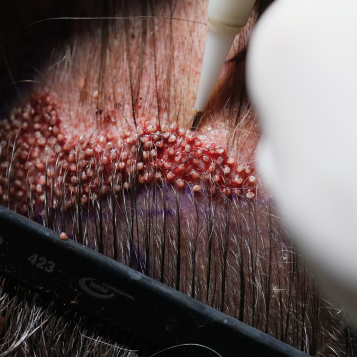
DHI has changed the game for women’s transplants. The idea: a Choi implanter pen places each follicle straight into the scalp, without a separate channel-cutting stage.The idea: a Choi implanter pen places each follicle straight into the scalp, without a separate channel-cutting stage. The advantage for women is considerable. No need to shave the recipient area: the follicles go in directly between your existing hairs, with millimetre control over angle, depth and direction. The result blends naturally into your hair, and no one notices a thing from the very first weeks.
-
 Shaveless FUE: maximum discretion
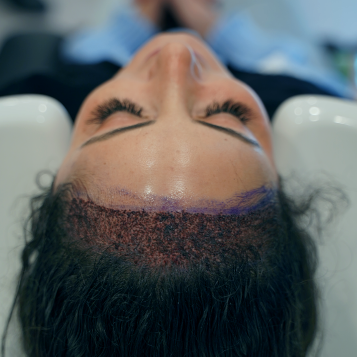
Standard FUE can also be done without a full shave. Only small patches of the donor area are discreetly shaved, easily hidden under longer hair. The 0.7 to 0.9 mm micro-punches heal quickly and invisibly. This technique is ideal when a large number of grafts is needed (beyond 2000), as it lets the surgeon draw on a wider donor area.
-
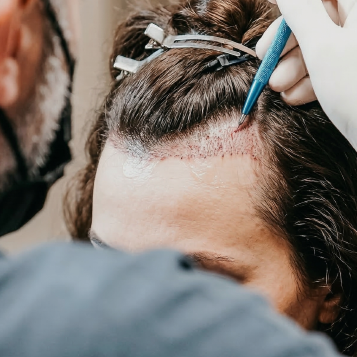 Sapphire FUE: precision at its peak
The premium version of FUE, the sapphire transplant uses synthetic sapphire blades to create the implantation micro-channels. The V-shaped sapphire blades cut cleaner channels than steel, which can mean less tissue trauma.The V-shaped sapphire blades cut cleaner channels than steel, which can mean less tissue trauma. It suits frontal density work in women particularly well, where precision makes all the difference between a natural result and an obvious one.


Are you a candidate for a hair transplant?
A hair transplant isn’t a fix for everyone. And that’s exactly why a careful assessment matters before you go ahead. Not every woman losing her hair is a candidate, and recognising that upfront saves disappointment later.
Who makes a good candidate

Stabilised androgenetic alopecia is the prime indication. Once the loss has been settled for at least 6 to 12 months and medical treatments haven’t restored a satisfying volume, a transplant becomes the logical answer. It is the commonest scenario: in a landmark retrospective study of 751 patients treated over 31 yearsin a landmark retrospective study of 751 patients treated over 31 years, 85% were at Ludwig stages I and II, meaning mild to marked thinning over the top of the head.
Traction alopecia is another excellent indication, provided the hair habits behind it (tight braids, extensions, pulled-back styles) have been given up for good. Frontal and temporal areas stripped by years of pulling can be restored with very good results.

Scalp scars (burns, surgical after-effects, accidents) are a classic indication. A transplant can cover these areas where the follicles have been destroyed for good.
Finally, some women simply want to build up a naturally high hairline or correct a gradually widening parting. Even without advanced hair loss, a transplant can give back the volume, and the confidence, that had gone missing.
The ideal profile

For a transplant to work, several things need to line up. The donor area (the occipital region at the back of the head) has to be dense enough, ideally above 65 follicular units per cm². The follicles there are relatively resistant to androgen hormones: once transplanted, they generally keep that resistance.The follicles there are relatively resistant to androgen hormones: once transplanted, they generally keep that resistance.
The hair loss has to be stable. Transplanting onto still-active alopecia is building on sand: the native hairs will carry on falling around the grafts, giving an uneven result within a year or two.
General health has to be good. No active scalp disease, no major clotting disorder, no heavy immunosuppressant treatment underway.
And above all, expectations have to be realistic. A transplant restores density; it doesn’t conjure a whole new head of hair from nothing. A patient with a thin donor area and Ludwig stage III will see a real improvement, but not a return to the density of her twenties.
The contraindications
Some situations mean a transplant has to be ruled out, or at least put off:
Diffuse unpatterned alopecia (DUPA) is the most important contraindication. When the loss affects the whole scalp, the donor area included, harvesting viable grafts becomes impossible. Transplanting follicles that are themselves already weakened invites a disappointing result.
Active scarring alopecias (lichen planopilaris, discoid lupus) are an absolute contraindication for as long as the disease is in an inflammatory phase. The risk isn’t only that the transplant fails, but that the underlying condition is made worse.

An ongoing telogen effluvium (after childbirth, stress or surgery) isn’t a reason for a transplant. Regrowth happens on its own in the vast majority of cases once the trigger is gone. Patience is the best ally here.
Finally, uncontrolled clotting disorders, certain anticoagulant treatments and active autoimmune scalp conditions all need to be talked through case by case with the medical team.
Results and recovery after your transplant
Weeks 1-2: the first few days
You are back to your usual routine within 2 to 3 days. Mild redness and small scabs form over the recipient area: perfectly normal and temporary. You are given a specific washing routine to help healing along without disturbing the freshly implanted grafts. Over the donor area, the micro-scars are invisible under the hair.
Weeks 2-6: shedding, the necessary passage
The transplanted hairs start to fall. This post-transplant shedding of the transplanted hairs isn’t just normalThis post-transplant shedding of the transplanted hairs isn’t just normal, it is a sign the follicles are moving into a resting phase before they wake up again. It is the most frustrating moment psychologically, but also the most predictable. The grafted follicles sit below the surface, getting ready to regrow.The grafted follicles sit below the surface, getting ready to regrow.
Months 3-4: the first shoots
The first fine hairs appear. Sparse and discreet at first, they thicken week by week. Regrowth is gradual and uneven from one area to the next: perfectly normal. Patience is the order of the day.
Months 6-9: the visible transformation
Density improves clearly. The grafted hairs thicken, lengthen, begin to merge with the existing hair. This is the stage where most patients start to see the difference in the mirror, and in how others look at them. Colouring, blow-drying, styling: you get your full freedom back.
Months 12-18: the final result
The follicles have reached full maturity. Density is at its highest and the blend is perfect. The grafts, taken from the more stable occipital area, generally keep that resistance.The grafts, taken from the more stable occipital area, generally keep that resistance.
And afterwards: the long-term upkeep
The grafted hairs are far less likely to thin.The grafted hairs are far less likely to thin. The surrounding native hairs, though, can carry on thinning if the androgenetic alopecia is still active. That is why a maintenance treatment (topical minoxidil, hair PRP sessions) is often recommended alongside the transplant, to steady the whole head of hair and protect the result over time.
The complete guide: women’s hair transplants in detail
Women’s hair transplants are booming. Long confined to the male world, hair restoration surgery is now fully open to women. The figures from the ISHRS (International Society of Hair Restoration Surgery) bear it out: the number of female surgical patients treated by ISHRS members rose 16.5% between 2021 and 2024the number of female surgical patients treated by ISHRS members rose 16.5% between 2021 and 2024. A strong trend, driven by better knowledge of the techniques, a freer conversation around female hair loss, and results that keep getting more convincing.
What makes a woman’s transplant different
It would be tempting to think a hair transplant is a hair transplant, whatever the patient’s sex. In reality, the female specifics are many and they shape the surgical plan directly.
The first difference is the pattern of the loss. In men, the bald zones are clearly mapped out: hairline, temples, crown. In women, the thinning is diffuse, gradual, and often covers the whole top of the head. The surgeon isn’t filling a bald patch, they are adding density to a thinned area. Implantation happens between existing hairs, which calls for greater precision and a technique suited to it.

The second difference is about shaving. A man will usually accept shaving his head for the procedure. A woman, rarely. Modern techniques (DHI, shaveless FUE) now make it possible to operate with no visible shave of the recipient area, and only a minimal, discreet shave of the donor area. For many patients that is the deciding factor.
The third difference is aesthetic. A woman’s frontal hairline is naturally different from a man’s: rounder, lower, with a softer outline. Implantation has to respect that geometry to give a harmonious result. Likewise, the direction and angle of the implanted hairs have to match the existing hair exactly. It is precision work that calls for specific expertise.
DHI or FUE: how to choose?

The choice of technique depends on your particular case. DHI (Direct Hair Implantation) is generally preferred in women for its knack of placing follicles between existing hairs while sparing as many native follicles as possibleplacing follicles between existing hairs while sparing as many native follicles as possible, and for needing no shave of the recipient area. The Choi pen gives precise control over the angle and depth of implantation.The Choi pen gives precise control over the angle and depth of implantation.
Standard FUE (Follicular Unit Extraction) or sapphire FUE stays relevant for cases needing a high number of grafts, where the area to treat is extensive. It allows a wider harvest and sometimes a shorter time in theatre.
A detailed DHI versus FUE comparison is available to help you understand the nuances between the two approaches. Whatever the case, it is your surgeon who, after examining your scalp and your donor area, will steer you towards the technique best suited to your situation.
The donor area: the make-or-break issue in women

This is probably the most delicate point of a woman’s transplant. The donor area, in the mid-occipital region (above the external occipital protuberance), has to be dense enough to supply the grafts needed. Clinical guidance puts the favourable threshold above 65 follicular units per cm². Below 40 units/cm², harvesting becomes risky and the result potentially insufficient.
Now, unlike men, whose occipital area is almost always spared by alopecia, some women show a diffuse thinning that reaches the back of the head too. This is precisely what is called DUPA (Diffuse Unpatterned Alopecia), and it is the major contraindication to a transplant. Harvesting follicles that are themselves weakened, to implant them elsewhere, courts a double failure: a poor result in the recipient area, and a depleted donor area.
That is why the pre-operative assessment matters so much. A good surgeon will say ‘no’ when a transplant isn’t the right call. And it is exactly that ‘no’ that protects patients from disappointing results.
The patient journey at Body Expert
At Body Expert, it all starts with a conversation from a distance. You send photos of your scalp (the top, the parting, the thinning zones, the donor area). Our surgeons look over your case, weigh up your eligibility and put a detailed treatment plan to you: recommended technique, an estimate of the number of grafts, and a package price.an estimate of the number of grafts, and a package price.
When you arrive in Istanbul, a clinical examination confirms and fine-tunes the plan. The procedure takes place in our partner clinic in Istanbul, selected for its facilities and its surgeons’ experience, with a team used to the specifics of women’s transplants. Your English-speaking coordinator is beside you at every stage, from the airport to the post-operative follow-up.

The way results develop follows a predictable calendar: the first fine hairs around the 3rd month, visible density between the 6th and 9th month, the final result between 12 and 18 months. The aftercare is spelled out in a protocol handed to you on the day, including the specific washing and shampooing advice, the positions for sleeping after your transplant, and the remote check-ups scheduled in.
Beyond the transplant: the complementary treatments
A hair transplant is designed to last on the transplanted follicles.A hair transplant is designed to last on the transplanted follicles. But androgenetic alopecia itself doesn’t stop. The native, non-grafted hairs can carry on thinning. That is why a stabilising protocol is often recommended alongside:

Topical minoxidil (the only drug approved by the FDA for female pattern hair loss)Topical minoxidil (the only drug approved by the FDA for female pattern hair loss) stimulates growth and slows the miniaturisation of the remaining follicles. Hair PRP sessions (Platelet-Rich Plasma) inject growth factors straight into the scalp to strengthen the existing follicles. In post-menopausal women, an oral anti-androgen (spironolactone) may be considered under medical supervision. Hair mesotherapy with Regenera Activa uses autologous micrografts from a small sample of your own scalp, not cultured stem cells, to support the follicles that remain.Hair mesotherapy with Regenera Activa uses autologous micrografts from a small sample of your own scalp, not cultured stem cells, to support the follicles that remain.
Understanding the hair cycle and the role of DHT in alopecia helps make sense of why these complementary treatments matter so much. The transplant restores density; the treatments alongside it keep that density over time.
In summary
A woman’s hair transplant is no longer a taboo subject. Fewer than 45% of women go through life with a full head of hair, and lasting solutions genuinely exist. The key is the assessment: identifying the type of alopecia, checking the donor area is dense enough, and making sure the loss has stabilised before considering surgery. A good candidate can get a natural, discreet and lasting lift in density.A good candidate can get a natural, discreet and lasting lift in density.
In women, it all comes down to finesse. The loss is diffuse, the frontal hairline is lower and rounder, and shaving the whole head is out of the question. That is why DHI with the Choi pen and shaveless FUE have come to the fore: they let the grafts go in between existing hairs, with no visible scar. The first hairs regrow around the 3rd month, density takes shape between the 6th and 9th month, and the final result is there to judge at around 12 to 18 months.
Choosing Istanbul means bringing together experienced surgeons, partner clinics selected against our quality criteria and English-speaking support from start to finish, for up to 70% savings compared with the UK. Still unsure about the number of grafts, the technique or your eligibility? Send your photos to our medical team: you get a personalised assessment and a free quote within 24 hours, with no obligation. Your hair restoration deserves a real expert opinion, not a decision made in the dark.
Sources and references
- Uebel, C. O., Piccinini, P. S., Spencer, L. S. B., & da Silveira, J. A. M. (2021). Female pattern hair loss: Why the follicular unit transplantation surgical technique remains a good option. Plastic and Reconstructive Surgery, 147(4), 839-849. https://pubmed.ncbi.nlm.nih.gov/33710162/
- Yun, D., Kim, D., et al. (2024). Clinical features of patients treated with hair transplants in female pattern hair loss. Annals of Dermatology, 36(6), 341-347. https://doi.org/10.5021/ad.23.158
- International Society of Hair Restoration Surgery. (2025). New survey finds younger adults, more women seeking treatment for hair loss. https://ishrs.org/2025-practice-census-results/
- True, R. H. (2021). Is every patient of hair loss a candidate for hair transplant? Deciding surgical candidacy in pattern hair loss. Indian Journal of Plastic Surgery, 54(4), 435-440. https://pmc.ncbi.nlm.nih.gov/articles/PMC8719975/
- Dinh, Q. Q., & Sinclair, R. (2007). Female pattern hair loss: Current treatment concepts. Clinical Interventions in Aging, 2(2), 189-199. https://pmc.ncbi.nlm.nih.gov/articles/PMC2684510/
- Goldin, J., Zito, P. M., & Raggio, B. S. (2025). Hair transplantation. In StatPearls. StatPearls Publishing. https://www.ncbi.nlm.nih.gov/books/NBK547740/
Before & After
Discover our patients’ results
Women's Hair Transplant

Avant-après

Avant-après

Avant-après

Avant-après
Your hair restoration starts here
Get a full hair assessment and a detailed, personalised quote within 24 hours, with no obligation.Get a full hair assessment and a detailed, personalised quote within 24 hours, with no obligation.
Our patients talk about us
FAQ: your questions on women’s hair transplants
Is a hair transplant painful?
No. The procedure is done under local anaesthetic, so the scalp itself is numb once it has taken effect.No. The procedure is done under local anaesthetic, so the scalp itself is numb once it has taken effect. At Body Expert, needle-free pre-anaesthesia makes even the injection of the anaesthetic comfortable. Afterwards the sensations stay very manageable and are well controlled with ordinary painkillers. Many patients are back to their activities within 2 to 3 days.Many patients are back to their activities within 2 to 3 days.
Do you have to shave your head for a woman’s transplant?
It is the question every woman asks, and the answer is reassuring. With the DHI technique, no shaving of the recipient area is needed. Only a small patch of the donor area (the back of the head) is discreetly shaved, easily hidden under existing hair. A transplant with no visible shave is how we usually plan a woman’s procedure.A transplant with no visible shave is how we usually plan a woman’s procedure.
How many grafts are needed?
It depends on how large the area to treat is, how much density remains and how strong the donor area is. Your surgeon gauges your needs precisely at the consultation, photos in hand.It depends on how large the area to treat is, how much density remains and how strong the donor area is. Your surgeon gauges your needs precisely at the consultation, photos in hand.
When can I style and colour my hair?
Gentle styling is fine from the second week. For colouring, allow 4 to 6 weeks after the procedure, the time for the scalp to heal fully. After that you get your full freedom back: blow-drying, dye, straightening, it all becomes possible again.
Does a transplant work on every hair type?
Straight, wavy, curly or afro hair can all be transplanted when the surgeon is used to that texture.Straight, wavy, curly or afro hair can all be transplanted when the surgeon is used to that texture. Curly or frizzy hair actually offers a natural aesthetic advantage, since each follicle visually gives more coverage than a straight hair.
Will my hair keep falling out after the transplant?
The grafted follicles come from the occipital area, genetically resistant to the hormones behind the loss. They generally keep that resistance.They generally keep that resistance. The native, non-grafted hairs, on the other hand, can carry on thinning if the androgenetic alopecia is still active. That is why a complementary treatment (minoxidil, hair PRP) is often recommended to steady the whole head of hair.
What are the risks in women?
Complications are rare and minor. Temporary redness, mild swelling of the forehead for 2 to 3 days, scabs that clear in 10 to 15 days. A temporary telogen effluvium of the existing hair can happen in the weeks after the procedure, but it reverses. Serious risks (infection, necrosis) are exceptional when an experienced team operates in a properly equipped clinic.
Is there a minimum or maximum age for a transplant?
There is no strict age limit. What matters is that the alopecia is stable and the donor area is viable. In practice, most patients are between 30 and 60, but women over 50 get excellent results, as do younger women in their thirties whose alopecia has been settled for several years.
Why choose Body Expert for my transplant?
Body Expert works with our partner clinic in Istanbul, selected for its facilities and its surgeons’ experience. Care is complete, from the first consultation to the post-operative follow-up, with a dedicated English-speaking coordinator at your side at every stage.
Discussing your project