Breasts
Natural augmentation
Reshaping
Implant-free
Breast lipofilling
Breast lipofilling, also known as fat transfer, adds natural volume to your chest using your own fat. No implant, no foreign body: we take fat from where you have a bit too much and reinject it into the breasts. You gain volume and refine your figure in a single procedure.
Breast lipofilling at a glance
Hospital stay
1 day
Wait before showering
4 days
Procedure duration
2-3 hours

Medical validation
Breast lipofilling: natural breast augmentation without implants
Plenty of women want a fuller bust without going down the implant route. After a pregnancy, some weight loss, or simply because nature was a little stingy, they look for something gentler and more natural. Breast lipofilling answers exactly that.

The idea is as simple as it is elegant: we take your own fat from where there’s a surplus (tummy, thighs, hips), purify it, then reinject it into your breasts. The result is a fuller chest and a slimmer figure in one operation. No foreign body, no implant to swap out in ten years, and a feel that stays completely natural.
Standardised in the 1990s by the American surgeon Sydney Coleman, after fat grafting had already been described in the late 19th century, the technique now has more than 25 years of clinical hindsight behind it. It has become the go-to alternative for women who want to stay themselves, only better. At Body Expert, our surgeons know this lipomodelling (reshaping the breast by injecting fat) inside out, and they take the time to map out with you the plan that best suits your body.
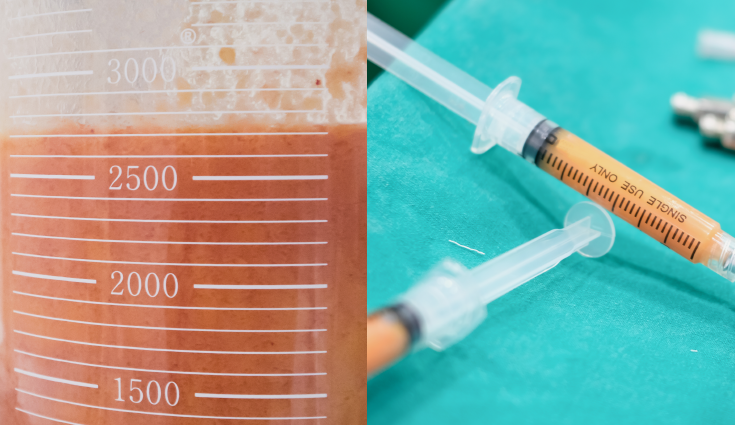
The operation takes between 2 and 3 hours under general anaesthetic, usually as a day case. The harvested fat is purified, often by centrifuge, to keep the most viable cells, then reinjected as micro-droplets in a fan-shaped pattern. That precision lets the surgeons sculpt the volume you want while helping the graft take. In practice, you gain up top while losing the little bulges that bothered you.
The stages of breast lipofilling
Pre-operative consultation
Your surgeon carries out a full clinical examination and studies your body shape to pinpoint the most suitable donor areas. They discuss what you’re hoping for, go through your medical history and set out the results you can realistically expect. Breast imaging is arranged when your age or history calls for it, often a mammogram from 40 onwards.
Liposuction and preparing the fat
The procedure takes place under general anaesthetic, as a day case in most cases. Fat is gently drawn off with fine microcannulas from the agreed areas (tummy, thighs, hips). It is then spun and purified to keep only the most viable fat cells, which gives the graft a better chance of taking.
Reinjection and shaping the breasts
The purified fat is reinjected into the breasts as micro-droplets, in a fan-shaped pattern across several tissue layers. Spreading it out this carefully helps the fat cells pick up a blood supply and lets the surgeon shape the volume you want with precision. The whole operation takes between 2 and 3 hours.
Aftercare and recovery
You’ll be advised to wear a support bra for 4 to 6 weeks. Swelling and bruising come up naturally and settle within 10 to 15 days. Steer clear of strenuous exercise for 3 to 4 weeks. Most women take 5 to 10 days off work to recover comfortably.

Enhance your bust naturally with Body Expert
The surgeons at our partner clinic guide you towards a result that's made for you, with a free personalised quote within 24 hours.
Our prices and packages
Breast Augmentation
Offre et tarif : Breast Augmentation
Feel free to scroll through the different prices from right to left!

How much does breast lipofilling cost?
As with any cosmetic surgery procedure, cost often weighs heavily on the decision. In the UK, breast lipofilling is a sizeable investment, in line with how technical the work is and the number of areas to treat. This is exactly where Turkey changes the picture.
In Istanbul, the same procedure lets you save up to 70%. Everything is organised for you: a 5-star hotel, VIP transfers, English-speaking support and 12 months of follow-up. The packages are set out just above, in our price list. A clear, transparent price, quoted from the outset, with no nasty surprises on arrival.

Lipofilling or implants: the real cost over time
Upfront, lipofilling sits in a similar range to having implants, because it takes more technical skill. But it’s over the long run that the maths tips in its favour: where breast implants need swapping after 10 to 15 years, reinjected fat doesn’t get replaced. No second operation to plan for, or to pay for. To weigh up the options calmly, have a look at our breast augmentation guide.
Want to know the exact price for your own plan? Our medical team will put together a personalised quote, free of charge, within 24 hours.
Your breast surgery plan deserves the best experts
Talk your plan through with the surgeons at our partner clinic and get a personalised quote within 24 hours, with no obligation.
Our patients talk about us
-
 Rym's
Rym's -
 Oceanie's
 -
 Jessy's
 -
 Lylia's


Frequently asked questions
Am I a good candidate for breast lipofilling?
Breast lipofilling suits women who have enough donor fat (tummy, thighs, hips) and who want a modest increase in size. Very slim women, or those after a big jump in volume, usually aren’t the best candidates. Your surgeon assesses whether it’s right for you at the pre-operative consultation.
How many cup sizes can you gain with breast lipofilling?
In a single session, lipofilling typically adds about one cup size. For a bigger increase, a second session can be considered after 6 months. Women wanting a gain of two cup sizes or more are usually pointed towards breast implants or a hybrid technique.
Is breast lipofilling painful?
Post-operative pain is usually mild to moderate, mostly in the areas where fat was taken, and much like the ache after a hard workout. A standard painkiller (paracetamol) is enough in most cases. The chest is often more comfortable than after implants, even if the donor areas stay sore for a few days.
How long do the results last?
Once the fat graft has settled (around 6 to 12 months), the result is lasting and permanent. Unlike implants, which have no obligation to be replaced on a fixed date, the fat that takes behaves like the rest of your body. Only a big change in weight would alter the volume you end up with.
Can you breastfeed after breast lipofilling?
Yes, breastfeeding is generally still possible after lipofilling. Fat is injected around the gland, without aiming at the milk ducts. Do let your surgeon know at the consultation if you’re planning a pregnancy, though.
Does breast lipofilling affect cancer screening?
France’s Haute Autorité de Santé (2015) notes that fat grafting can leave marks on imaging, as any breast surgery can. UK guidance (Lowes et al., 2018) does not recommend routine scans under 40 if examination is normal; from 40, a mammogram is usual. After surgery, screening follows the NHS programme for your age, not a yearly mammogram and ultrasound for everyone.
Can lipofilling be combined with breast implants?
Yes, pairing lipofilling with implants (the ‘composite’ technique) is entirely possible and increasingly common. Here the fat fine-tunes the natural look of the implants, especially around the cleavage and the edges of the breast. This can be done in one operation or in two separate stages.
Why choose Body Expert for breast lipofilling?
Body Expert looks after you in our partner clinic in Istanbul, with surgeons who specialise in breast surgery. Everything is organised for you: a 5-star hotel, VIP transfers, English-speaking support and 12 months of follow-up. You get experienced surgeons at prices far more affordable than back home.
Let’s discuss your project
A closer look at breast lipofilling
Why so many women choose lipofilling
The appeal of breast lipofilling comes down to one word: natural. Unlike implants, autologous fat (your own fat) blends gently into the tissue that’s already there. By touch, the result feels like natural breast tissue, and the tiny scars fade once they have healed. The stem cells in the transferred fat even improve the skin quality across the cleavage, a bonus our patients love.
The other big draw is that there’s no foreign body at all. No risk of rejection, no capsule forming around an implant, and no device to replace as the years go by. Scars come down to tiny entry points of 2 to 3 mm, all but invisible once healed. And the icing on the cake: the liposuction that comes with it slims your figure exactly where you want. Plenty of patients tell us it was this “two in one” that won them over.
Recovery is also lighter than after implants: less tightness in the chest, a quicker bounce-back, an easier return to everyday life. That’s what’s behind the enthusiasm for this technique, driven by the same wish in every patient, a result that genuinely looks natural.

Are you a good candidate for lipofilling?
Breast lipofilling isn’t for everyone, and that’s exactly what makes it work so well: when the profile fits, the results are excellent. In practice, the ideal candidate ticks a few boxes.
You need enough donor fat to work with. The tummy, thighs, hips and flanks are the most common harvest sites. You don’t have to be overweight, but very slim women, with a BMI below 18-19, generally won’t have the reserves for a meaningful transfer.
Lipofilling is also a great fit for women who want to correct a slight asymmetry between the two breasts, fill a hollow in the cleavage, or improve the look of implants already in place. After a breast lift (also called mastopexy), it rounds off the result by adding volume where it’s missing.
There are some contraindications, though. Smoking is a major obstacle: nicotine hampers the small blood vessels and clearly reduces how many grafted fat cells survive. Our surgeons ask you to stop smoking 4 weeks before and after the operation. Women with a history of clotting disorders or certain autoimmune conditions are assessed more closely.

What to know before you go ahead
Lipofilling has its limits too, and it’s worth knowing them so you can decide with your eyes open. The gain in volume stays modest: reckon on about one cup size extra per session. If you’re dreaming of going from an A cup to a D, this technique alone won’t get you there. But for a subtle, balanced shape, it’s ideal.
Something else to plan for: the fat naturally reabsorbing. On average around 54% of the injected volume remains (Hu and Xu, 2024). Surgeons know this and often overfill a little from the start to offset it, which is a completely normal part of the process. And, as noted, you need enough fat reserves: very slim women aren’t the best candidates.
In some cases, a second session can be considered after 6 months to refine the result or reach the volume you’re after. There’s nothing worrying about this top-up: it simply fine-tunes the outcome with even more precision.

Recovery day to day
One of the perks of lipofilling is a fairly gentle recovery compared with other cosmetic surgery procedures. Here’s what to expect, in practical terms.
For the first few days, you’ll feel achy where the fat was taken, a bit like after a heavy gym session. A simple paracetamol painkiller does the job in the vast majority of cases. Swelling and bruising come up naturally over the liposuctioned areas and settle within 10 to 15 days.
You’re advised to wear a support bra for 4 to 6 weeks, day and night. This small habit helps hold the grafted fat in place and speeds up healing. A compression garment goes over the donor areas too, to keep swelling down.
On the practical side, plan for 5 to 10 days off work. Avoid strenuous exercise for 3 to 4 weeks, though gentle walking is encouraged from the very next day to get the circulation going. You ease back into sport gradually, usually after about a month. At Body Expert, we hand you a detailed aftercare plan and our team stays reachable throughout your recovery.

When do you see the final result?
The result comes together in stages. In the very first days, your breasts will look fuller because of the swelling. That swelling settles within 3 to 6 weeks. The fat finishes reabsorbing around the 3rd month, and the final result settles between 6 and 12 months.
Once the graft has settled, the volume you’ve gained is lasting and permanent, as long as your weight stays steady. A welcome bonus: breast sensation is preserved and breastfeeding is generally still possible. The Haute Autorité de Santé (2015) notes that lipofilling can leave imaging marks, as any breast surgery can. UK guidance (Lowes et al., 2018) recommends a pre-operative mammogram from 40 onwards if examination is normal, then NHS screening according to age, not a yearly mammogram and ultrasound for everyone.

Lipofilling in breast reconstruction
Beyond pure aesthetics, lipofilling plays an important part in breast reconstruction after breast cancer. Many women who’ve had a mastectomy turn to it to rebuild a natural breast without an implant. Fat transfer slowly rebuilds the lost volume, session after session, with a surprisingly natural look.
Professor Emmanuel Delay, in France, did much to popularise this breast lipomodelling and to help document its safety. The 2023 position paper from the CNGOF breast committee is more cautious: most studies have not shown a higher risk of recurrence when the procedure waits until treatment has ended, but long-term data remain limited and they follow the HAS waiting rules. For the women concerned, that still marks a real step forward.

Lipofilling or implants: how to choose
It all comes down to what you want and your body shape. Lipofilling is right for you if you’re after a modest, very natural-looking increase, if you have enough fat reserves and if you’d rather avoid any foreign body. Breast augmentation with implants, on the other hand, is better suited to a big increase in volume or a more projected cleavage.
There’s also a third route, increasingly common: the composite technique, which marries the projection of implants with the natural feel of lipofilling. This hybrid approach offers the best of both worlds and appeals to a growing number of women who want a result that’s both full and natural to the touch.
| Criterion | Lipofilling | Implants | Composite technique |
| Volume gained | About 1 cup per session | 1 to 3+ cups | 1 to 3+ cups |
| Feel to the touch | Very natural | Natural to firm | Natural |
| Scars | Barely visible (2-3 mm) | Visible (3-5 cm) | Visible |
| How long it lasts | Permanent | No fixed replacement date | No fixed date |
| Foreign body | No | Yes | Yes |

Why have your breast lipofilling in Istanbul with Body Expert?
Breast lipofilling calls for genuine surgical skill. How the fat is harvested, how it’s purified and how it’s reinjected all bear directly on the final result. At Body Expert, our surgeons who specialise in breast surgery work in our modern Istanbul clinic, fitted with the latest-generation equipment.
Your care is complete and direct, with no middleman: a detailed pre-operative consultation, imaging, the operation, post-operative follow-up and support from a dedicated English-speaking coordinator. With up to 70% savings compared with the UK, your breast surgery plan finally becomes affordable. The packages are set out in full in our price list, higher up this page.
In summary
Breast lipofilling builds up the bust with your own fat, with no implant and no foreign body. Its main strength is a natural result, by touch and by sight, paired with a genuine bonus: the liposuction that redraws your figure along the way. The gain stays measured, on the order of half a cup to a full cup per session, which makes it ideal for a harmonious shape rather than a dramatic change.
A good candidate? You are if you have enough fat reserves and you don’t smoke, since smoking undermines the survival of the grafted cells. You also need to accept some reabsorption, 20% to 40% of the injected volume, which the surgeon plans for by overfilling. On recovery, reckon on a support bra for four to six weeks and five to ten days off work. The result settles between six and twelve months, then stays durable as long as your weight holds steady.
Natural, safe for breast monitoring and useful even in reconstruction, this technique has won over patients and surgeons alike. That leaves the question of budget: by having it done in Istanbul with Body Expert, you get experienced surgeons, partner clinics selected against our quality criteria and English-speaking support from A to Z, for up to 70% savings compared with the UK. Want a clear picture of your own plan? Ask for your free, personalised quote and we’ll reply within 24 hours.
Sources and references
- Coleman, S. R. (2006). Structural fat grafting: more than a permanent filler. Plastic and Reconstructive Surgery, 118(3 Suppl), 108S-120S. https://doi.org/10.1097/01.prs.0000234610.81672.e7
- Haute Autorité de Santé. (2015). Évaluation de la sécurité et des conditions de réalisation de l’autogreffe de tissu adipeux dans la chirurgie reconstructrice, réparatrice et esthétique du sein. https://www.has-sante.fr/jcms/c_1778570/fr/evaluation-de-la-securite-et-des-conditions-de-realisation-de-l-autogreffe-de-tissu-adipeux-dans-la-chirurgie-reconstructrice-reparatrice-et-esthetique-du-sein
- Haute Autorité de Santé. (2020). Techniques de reconstruction mammaire autologues, alternatives aux implants mammaires. https://www.has-sante.fr/jcms/c_2965016/fr/techniques-de-reconstruction-mammaire-autologues-alternatives-aux-implants-mammaires-rapport-d-evaluation-technologique
- Molière, S., Boutet, G., Azuar, A.-S., et al. (2023). Le lipomodelage du sein dans un contexte cancérologique : mise au point à partir d’une revue de littérature actualisée et des référentiels nationaux et internationaux. Gynécologie Obstétrique Fertilité & Sénologie, 51(10), 471-480. https://doi.org/10.1016/j.gofs.2023.07.001\n5. Hua, S., & Xu, H. (2024). Volume retention rate after breast autogenous fat grafting and related influencing factors: A systematic review and meta-analysis. Journal of Plastic, Reconstructive & Aesthetic Surgery, 89, 105-116. https://doi.org/10.1016/j.bjps.2023.12.003