Gynaecomastia: diagnosis, techniques and recovery
One adult man in three has some form of gynaecomastia, meaning an overgrowth of breast tissue made up of gland, of fat, or of both at once. In the vast majority of cases that volume is benign. What still needs sorting out is where it comes from, and that means a clinical examination and, when the picture calls for it, a work-up. This guide follows that route, from diagnosis to the choice of technique, through to recovery and how an operation in Istanbul is organised.
Gynaecomastia at a glance


Introduction
What gynaecomastia is
Breast volume in men can be glandular, fatty, or both at once, and how much of it there is decides how visible it becomes: under a fitted shirt it turns into a daily nuisance long before it ever hurts. Pain is rarely what brings men to a consultation. What brings them is the social weight of a chest that shows. When correction is indicated, the aim is a flatter, more masculine chest where breast volume no longer sits in the foreground.
The causes fall into a few broad families. A hormonal imbalance, with a relative excess of oestrogen, explains a good share of cases. Then come the forms triggered by a medicine, those linked to weight gain, and those whose origin stays hidden even after a full work-up: that last group is called idiopathic. The lesion is usually benign, which does not excuse skipping the search for a cause before an operation is considered, because a hormonal swelling, a drug-induced swelling and a fatty swelling call for neither the same timing nor the same procedure.
That search has a practical payoff: it stops you being operated on too early, or treated for something other than the real problem. Chest fat tied to body weight is not the same conversation as a firm gland that has been sitting there for years, and a medicine still being taken is not the same conversation as an old, already fibrous form that no diet will shift. So the reasoning runs in three stages: diagnosis first, then the nature of the tissue, then the technique.

Fat, gland, or a mix of both
What the volume is made of varies from one man to the next, and that is what dictates the procedure. Adipomastia is a local excess of fat; true gynaecomastia means the gland itself has grown; the mixed form combines both tissues and is the one seen most often in clinic. A soft pad of fat and a firm core sitting behind the nipple do not call for the same surgery, which is why a photograph is never enough to choose a technique: it shows a volume and says nothing about the tissue underneath.
The examination settles that question. The surgeon palpates, compares both sides, looks at the areola, the skin and how firm the tissue feels; he is looking for a glandular core, a ring of fat around it, any skin excess that would still be there once the volume is gone, and he notes the asymmetry, which is common, along with how well the skin is likely to redrape. The SIAMS guidelines make this clinical examination the cornerstone of diagnosis. Hormone blood tests and imaging come in afterwards, when the history, the age, the palpation or a warning sign make them useful.
Everything else follows from that distinction. Two chests that look alike under a shirt will not get the same operation: adipomastia points towards liposuction, a firm, localised gland with little fat around it points towards glandular excision, and the mixed form points towards doing both in one session. When skin is left over, after major weight loss or a severe gynaecomastia, a reduction with skin excision enters the discussion, on the same logic as body contouring after weight loss. The technique therefore follows what the examination establishes, and it is decided case by case.

Teenagers, recent forms, long-standing forms
Not every gynaecomastia needs an operating theatre. Physiological or recent forms are monitored, and in teenagers the volume sometimes settles on its own; psychological support keeps all its value at that age, especially when the social impact weighs heavier than the volume itself. SIAMS makes the point: watchful waiting has a real place in management, and a chest that may still change is better discussed with that bit of distance than in a hurry.
Surgery takes over for long-standing fibrous gynaecomastia, or when the psychological impact is real. The words matter here: “long-standing” and “fibrous” describe tissue that has organised itself and lost the softness of a recent flare. A diet brings down chest fat, it does not make an established gland disappear. That is exactly what the examination and, if needed, the work-up are for: telling apart what can still regress from what now needs surgery.
Psychological impact counts towards the indication, under those same guidelines, once it is established. The point is not to answer a passing self-consciousness, but to recognise that a settled, visible volume that weighs on how you dress, train and socialise can justify correction, once the diagnosis is made and active causes have been ruled out or brought under control.
That leaves the choice of procedure, and the choice follows the tissue found: liposuction, excision, both together, skin excision when the surplus demands it, possibly lipofilling or pectoral implants once the breast volume has been dealt with. A fuller technique only earns its place if both tissues are present, while a lighter technique leaves behind whatever it does not treat. The literature points the same way: a review of 94 studies, covering 7294 patients, reports a complication rate of 11.76% for combined techniques, against 30.64% for surgical excision alone and 14.87% for suction-only techniques. Those figures describe a risk profile rather than an absence of complications, and they suggest that pairing the two procedures, when both tissues are there, is often the more coherent option.

What the work-up and preparation change
Before theatre, the first step is knowing exactly what is being operated on: examination, photographs, and a conversation about what you want as much as about what surgery can reasonably deliver. Several situations push the procedure back, because they bear directly on risk: a hormonal imbalance that has not been brought under control, breast or testicular disease, a clotting disorder, significant obesity, heavy ongoing smoking, or an unstable psychiatric condition. The large series of 4996 patients shows what is at stake here, with 4.4% complications at 30 days; high BMI, clotting disorders and inpatient management, itself a marker of a heavier than average procedure, come out as independent risk factors. Preparing a patient therefore means clearing away whatever would tip a well-framed operation into a riskier one.
In practice, smoking usually stops at least one month before surgery, and weight needs to be stable before a date is set. A work-up fills in the picture if the examination calls for it, then the surgical plan is drawn up: liposuction, excision, both, skin excision where appropriate. That weight stability is not a box-ticking exercise, because a chest operated on and then subjected to weight regain, or operated on while obesity is still marked, will not hold the same contour. The series already cited confirms it in its own way, since high BMI is among the independent risk factors.
Comparing a UK quote with an Istanbul package helps you decide, without ever standing in for a medical indication. An attractive price applied to a gland that should not have been removed, or set on top of a hormone work-up left undone, has no medical value. The order stays the same in every case: diagnosis, indication, technique, then the travel arrangements.

Having surgery in Istanbul with Body Expert
Body Expert works as a direct clinic and handles your file from end to end, with more than 50000 procedures carried out overall, surgeons based in Istanbul and English-speaking support from start to finish. Our partner clinic in Istanbul is selected for its facilities and its surgeons’ experience. The package covers a 5-star hotel with your nights and breakfast, VIP transfers between the airport, the hotel and the clinic, and post-operative follow-up over 12 months, for savings of up to 70% against the prices usually charged in the UK. You book your own flights, and the quote reaches you within 24 hours, free and with no obligation.
The pathway starts remotely, with photographs and a video call. You then travel to Istanbul for the operation, before heading home with a care plan and follow-up in English. The detail of the stay is on the gynaecomastia in Turkey page.
Those 12 months of follow-up count as much as the operation itself. They cover the period when the contour settles, the scars fade and the advice gets adjusted: a clear photograph sent at the right moment, a question asked, a recommendation made more precise. Your chest keeps changing with your weight and your hormone balance, and that is also what this year of follow-up is there to watch.
Sources
- Pozza, C., Selice, R., Barbonetti, A., Hasenmajer, V., Lotti, F., Menafra, D., Pasquali, D., Sansone, A., Isidori, A. M., & Rochira, V. (2026). Management of gynecomastia in adolescence and adults: the clinical practice guidelines from the Italian Society of Andrology and Sexual Medicine (SIAMS). Journal of Endocrinological Investigation.
- Innocenti, A., Melita, D., & Dreassi, E. (2022). Incidence of Complications for Different Approaches in Gynecomastia Correction: A Systematic Review of the Literature. Aesthetic Plastic Surgery, 46(3), 1025-1041.
- Knoedler, L., Knoedler, S., Alfertshofer, M., et al. (2024). Gynecomastia Surgery in 4996 Male Patients Over 14 Years: A Retrospective Analysis of Surgical Trends, Predictive Risk Factors, and Short-Term Outcomes. Aesthetic Plastic Surgery, 48(22), 4642-4650.
How the procedure unfolds
The surgeon works out which type of gynaecomastia you have through a clinical examination, backed up by photographs and a conversation about the result it is reasonable to expect. He tells fat from gland, then proposes liposuction, excision, both together, or a skin reduction.
The first discussion happens remotely, with photographs and a video call. You then come to Istanbul, where a 5-star hotel, VIP transfers and an English-speaking patient coordinator are waiting for you. You book your own flights, and the quote arrives within 24 hours.
The operation takes 90 minutes to 2 hours 30 on average, depending on the volume to treat. Liposuction comes before glandular excision when both tissues are present. In one large series, 95% of operations are done as day cases.
The compression vest is worn for 4 to 6 weeks. Pain and bruising settle over 2 to 3 weeks, and hard training waits at least a month. At Body Expert, post-operative follow-up runs for 12 months.

Reshape your silhouette with Body Expert
Ask for a free quote within 24 hours and get a first opinion on your chest, with no obligation.
Surgical techniques
-
 Liposuction alone
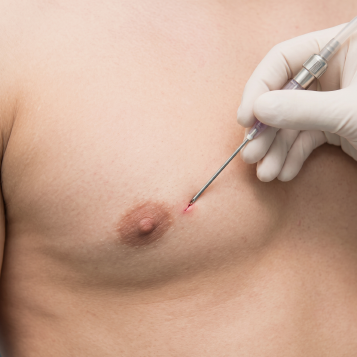
When the volume is mostly fatty, with no enlarged gland behind it, liposuction on its own can be enough. The incisions stay small and discreet, but this is still surgery: suction takes out the fat and leaves any firm glandular core exactly where it was.
-
 Glandular excision alone
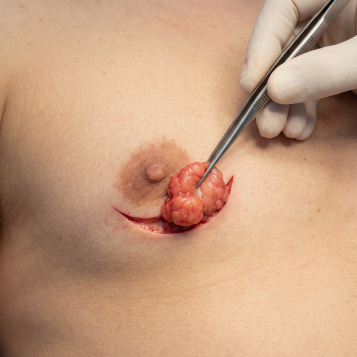
Faced with a firm, localised gland surrounded by little fat, the surgeon removes the excess breast tissue, usually through a peri-areolar incision, sometimes through the armpit. The scar then blends into the colour of the areola instead of running across the chest.
-
 Liposuction and excision combined
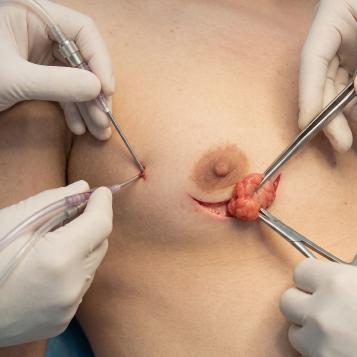
In the mixed form the fat is suctioned first, then the gland removed: this is the most common scenario. A review of 94 studies, covering 7294 patients, reports 11.76% complications for these combined techniques, against 30.64% for excision alone and 14.87% for suction alone.
-
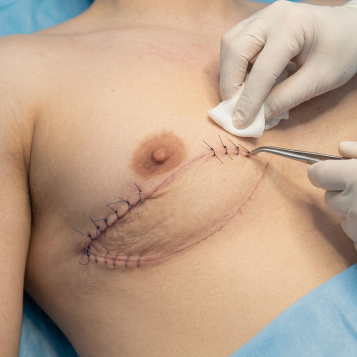 Reduction with skin excision
Severe gynaecomastia, major weight loss, skin left over once the volume is gone: skin excision sometimes becomes necessary. The scar is then longer, which is spelled out clearly before the operation, and it stays preferable to a skin surplus that would hang as a fold.
-
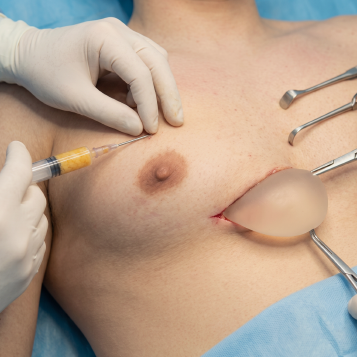 Other options
Beyond a flat chest, some men want a more muscular shape. Lipofilling, which reinjects your own fat, or pectoral implants can then be discussed case by case, once the breast volume has been treated, outside the standard package.


Indications and contraindications
Indications
Surgery enters the discussion in five main situations: a gland that persists despite medical treatment, chest fat that resists exercise, a form with no identified cause that settles in over time, a gynaecomastia triggered by a medicine where stopping it was not enough, and a volume that forms part of wider medical care. In every case, the right candidate is in good general health with a weight that has stabilised.

Persistent glandular hypertrophy covers the cases where medical treatment has already been tried, or no longer has a role, and the gland is still there. Palpation finds a core, where adipomastia gives up only a soft pad; at that stage, no diet replaces excision. This is one of the clearest indications, particularly once the tissue has turned fibrous and long-standing, as the SIAMS guidelines point out.
Adipomastia, for its part, follows a different logic, since it is an excess of fat localised over the chest. Exercise and weight loss shift some of it. When that fat holds out, when the weight is already stable and the volume still shows under a fitted shirt, liposuction becomes worth discussing; if a gland comes with it, suction alone will not be enough.
Then comes idiopathic gynaecomastia, the volume whose origin the work-up never finds. No identified cause does not close the door on correction, it simply means the investigations have to be seen through before concluding. If the volume persists and keeps bothering you once that work-up is exhausted, surgery treats the tissue actually present, gland or fat, and gives a concrete answer where the cause stays unknown.
Drug-induced gynaecomastia follows certain treatments, hormonal ones in particular. Stopping the medicine, where that is possible, is the first step. If it is not enough and the volume stays, the surgical discussion resumes on the same footing as in the other forms: fat, gland, skin, impact. A treatment still under way and a residual volume after stopping belong to different moments in the pathway.
Lastly, a gynaecomastia linked to a health problem sits within wider care, where the chest is only part of the file. The surgical indication, when it comes, arrives once that health problem has found its own care pathway.
In all these situations the operation has the same goal: a flatter, more masculine chest, and far less awkwardness when dressing, training and socialising. It is aimed at a patient in good general health whose weight has settled. That weight stability governs how the contour holds over time and eases the surgical risk, high BMI being among the independent risk factors in the series of 4996 patients.

Contraindications
Six situations mean postponing the operation, or treating something else first: hormones that are not under control, breast or testicular disease that belongs in another care pathway, a clotting disorder, marked obesity, heavy ongoing smoking, and an unstable psychiatric condition. Timing weighs as much here as the choice of clinic, because postponing means putting the procedure back into a window where the risk is acceptable again.
A hormonal imbalance that is not under control weighs on the indication for two reasons: the volume may still change, and the underlying disorder is untreated. The SIAMS guidelines put the examination, then the work-up if needed, before the procedure. Operating on a chest whose hormone balance is still moving means working on a picture that has not settled; the cause is treated or stabilised first, and the chest is discussed again afterwards.
Breast or testicular disease belongs in another care pathway. Gynaecomastia correction is the setting neither to investigate it nor to treat it, and surgery on a benign volume waits until that pathway has done its job.
Clotting disorders raise the surgical risk. In the series of 4996 patients they stand out as an independent risk factor for complications at 30 days, alongside high BMI and inpatient management, itself a marker of a heavier than average procedure. A known but unassessed disorder therefore postpones the operation, on the strength of a factor identified across a large cohort.
Marked obesity points towards weight loss first. Chest volume in that setting is often partly fatty, and the surgical risk climbs with BMI in the series cited. Drawing a contour on a chest that is still shifting makes less sense than reaching a stable weight beforehand: the good-candidate criterion mentioned above and this temporary contraindication line up exactly.
Heavy ongoing smoking is another reason to postpone, since tobacco weighs on healing and on recovery. Stopping for at least one month before surgery is often set as a condition for the procedure to go well.
An unstable psychiatric condition also means waiting. The indication, when it rests on a real psychological impact, assumes that impact can be discussed on stable ground, and an irreversible procedure is not placed on a psychiatric picture that is still moving. These contraindications are temporary or longer-lasting depending on the case: once the picture has settled, surgery becomes open to discussion again.
Recovery and complications
The first few weeks
The hospital stay is short, most often limited to the day itself. In the series of 4996 patients, 95% of operations are day cases, which means going back to the hotel the same day in the large majority of cases. An overnight stay is still possible when the surgeon judges it wiser, particularly for a heavier procedure, since inpatient management shows up as a risk marker in that same series. The number of hotel nights, for its part, is worked out in the quote, before you arrive.

The first few weeks follow a set protocol. The compression vest is worn for 4 to 6 weeks: it limits swelling and helps the skin redrape, two things that happen far less easily without it. Allow 2 to 3 weeks for pain and bruising to settle noticeably, bearing in mind that this window describes the return to everyday comfort and not the return to training. Hard physical effort is off the table for at least one month, even though the contour already looks sharper by then. Massage and lymphatic drainage can speed up the deswelling; they are offered case by case and are not part of the package by default.
1 to 2 weeks off work is common, the length depending on what you actually do: a physical job puts far more strain on the operated chest wall than desk work, and the sick note is adjusted accordingly. The scars, usually peri-areolar, stay discreet and fade over the months. How discreet they end up depends on your skin, on the way you heal and on sun exposure, which they should not get too early. The 12 months of follow-up are also there to keep an eye on that.
Getting back to sport
The gym waits until the second week, and the return then happens in stages, under the surgeon’s eye. Allow a month minimum before intensive training, often more if the excision was wide: two extra weeks of patience beat a haematoma brought on by going back too soon. The vest, worn for 4 to 6 weeks, supports this phase by holding the chest while the swelling goes down.

Walking opens the return because it does not pull on the operated chest wall, unlike press-ups or chest work in the gym, which come a good deal later. That progression is discussed with the surgeon, photographs in hand, taking account of how extensive the procedure actually was.
Complications that can happen
Incidents do occur, even if they stay in the minority: haematoma, infection, a small limited area of skin necrosis, slight asymmetry, or loss of sensation in the areola, usually temporary. In the review covering 7294 patients, the complication profile varies with the technique used, at 11.76% for combined techniques, 30.64% for surgical excision alone and 14.87% for suction-only techniques. The series of 4996 patients reports 4.4% complications at 30 days for its part. The two results do not contradict each other: the first compares techniques across 94 studies, the second measures the short term in a single cohort. Surgery here stays a well-framed procedure whose pressure points are known, namely weight, clotting, tobacco and sticking to the instructions.

Revision surgery remains possible later, for a scar or a contour that does not suit you. The subject is raised before the operation, at a point when the decision can still take a second stage into account, even though these revisions stay uncommon.
Once the gland and the excess fat are out, recurrence is rare. Marked weight gain or a fresh hormonal imbalance can still bring volume back, which is why it pays to keep your weight roughly steady and never to adjust an ongoing hormone treatment on your own. Endocrine follow-up where relevant, and the 12 months of Body Expert follow-up, provide that watchfulness over the period when the chest settles.
Results over time
The goal is easy to state: a flatter, firmer, more masculine chest, and fitted clothes worn without a second thought. Scars soften with time and, in the usual scenario, the contour obtained holds as long as the indication was right, the instructions were followed and your lifestyle keeps up. Some marks may stay visible; what matters is that breast volume no longer takes up space in your daily life.

Lipofilling and pectoral implants, mentioned earlier, can round out the shape once the result has settled, outside the standard package. Post-operative follow-up, for its part, runs for 12 months at Body Expert and rests on regular contact, photographs and questions included, throughout the period when the contour takes shape.
Reshape your silhouette with Body Expert
Send your photos and get an opinion within 24 hours on whether an operation, a work-up or simply waiting makes most sense.
FAQ
Which technique is right for me?
It all depends on what palpation finds, fat, gland or both, and on the state of the skin covering the volume. Adipomastia points towards liposuction, a firm gland towards excision, a mixed form towards doing both. No online algorithm replaces that examination.
How long do the operation and the hospital stay take?
Allow 90 minutes to 2 hours 30 in theatre depending on the volume to treat. Day surgery is the rule, since 95% of operations in a series of 4996 patients happen on the same day. An overnight stay is still possible if the surgeon prefers it. You book your own flights.
Can gynaecomastia come back?
Once the excess tissue is removed, recurrence is uncommon. Marked weight gain or a fresh hormonal imbalance can bring volume back, which is why it makes sense to keep a stable weight and stay under review, through the 12 months Body Expert provides.
When can I train again?
Intensive training waits at least one month. Walking opens the return, while press-ups and chest work in the gym come much later. The vest stays on for 4 to 6 weeks, and progression is discussed with the surgeon, photographs in hand.
What does the Body Expert package cover?
The package covers the 5-star hotel with breakfast, VIP transfers, a dedicated English-speaking patient coordinator and post-operative follow-up over 12 months, with a free quote within 24 hours and no obligation. Lipofilling, pectoral implants and massage are possible extras, decided case by case.
Can liposuction be combined with surgical excision?
Yes, and in mixed forms it is the most common scenario: the fat is suctioned, then the gland removed. A review of 94 studies, covering 7294 patients, reports a complication rate of 11.76% for these combined techniques, against 30.64% for excision alone.
What are the advantages of gynaecomastia surgery in Turkey?
Body Expert works as a direct clinic in Istanbul, with more than 50000 procedures overall and English-speaking support from start to finish. The package covers the 5-star hotel, VIP transfers and follow-up over 12 months, with savings of up to 70% on UK prices.
How is the diagnosis made?
The SIAMS guidelines make clinical examination the cornerstone of diagnosis. The surgeon compares both sides, palpates the glandular core, looks at the areola and judges the quality of the skin. Blood tests and imaging come next, when the history or the palpation makes them useful.
Discussing your project