Buccal fat removal: slimmer cheeks and a sculpted face
Do your cheeks look a touch too round or too full? Buccal fat removal brings down the volume of the buccal fat pads to slim the middle of the face and bring out your cheekbones. It’s a short procedure, with no visible scar, and our medical team is with you from start to finish.
Understanding buccal fat removal


Why consider buccal fat removal?
Full, rounded cheeks can leave the face looking younger than you’d like. Buccal fat removal (also called bichectomy) offers a lasting answer: by reducing the volume of the buccal fat pads, the small pockets of fat tucked deep in the cheeks, it slims the middle of the face and brings out the line of the cheekbones and jaw.

Despite what the name suggests, it’s never a full removal. Our surgeons always leave part of the pad in place, because removing it all can leave the face looking hollow as you age. The procedure is simple, quick and leaves no visible scar, because it’s done from inside the mouth.
At Body Expert, we treat this as one piece of a wider facial balance, alongside our other facial cosmetic surgery procedures. Here’s what’s worth knowing before you go ahead.
The stages of your journey
It all starts with an online chat with your dedicated patient coordinator, plus our surgeons’ opinion from your photos. We look at whether the procedure suits you and decide together on the result you’re after, openly and with no surprises.
We send you the list of pre-operative tests and all the practical advice you’ll need. Hotel, transfers and your English-speaking coordinator are arranged for you, so you can set off with a clear mind.
From the moment you land, we sort the transfers between the airport, your hotel and our partner clinic. You have one last consultation with your surgeon before the day of the procedure.
Usually done under local anaesthetic, buccal fat removal takes around 30 to 45 minutes. The incision sits inside the mouth, so it leaves no mark on the outside of the face.
Mild swelling is normal for 7 to 10 days. An ice pack, soft food and painkillers if you need them keep you comfortable through this short phase.
Your follow-up carries on remotely with our medical team, who stay reachable for any question once you’re back home.
Everyday activities pick up again within a few days, and the result takes shape over 3 to 4 weeks, refining further over the months that follow.

Fancy a more sculpted face? Let’s talk.
Our specialists will call you back within 24 hours to talk through your plans, free of charge and with no obligation.
Which approach suits your face?
-
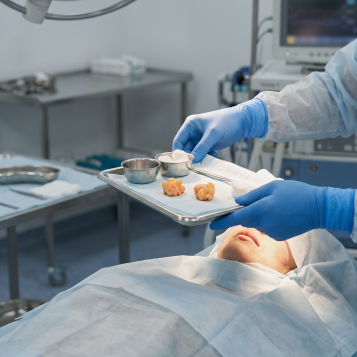 Buccal fat removal on its own
Done from inside the mouth, typically removing 2 to 5 ml of fat per side. The go-to option for lastingly slimming full cheeks, with no visible scar.
-
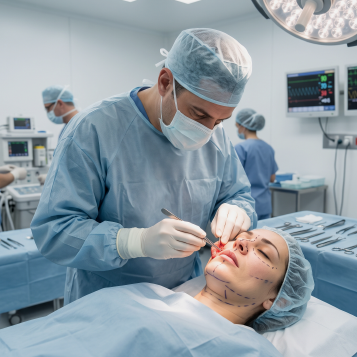 Combined with other procedures
Paired with a rhinoplasty, a facelift or chin liposuction during the same stay, for a complete, coherent facial balance.
-
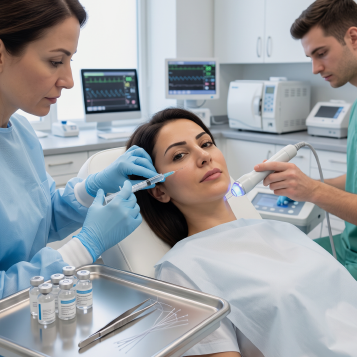 Non-surgical alternatives
Hyaluronic acid to shape the cheekbones, thread lifts or radiofrequency to firm the skin. Gentler options, with shorter-lived results.


Common questions about buccal fat removal
Does buccal fat removal hurt?
Not really, it’s more of a nuisance than genuinely painful. The aftermath is similar to having a wisdom tooth out, and ordinary painkillers keep it well under control.
Will there be a scar?
No visible scar: the incision is made inside the cheek, completely hidden from the outside.
How long does the swelling last?
Swelling sticks around for 7 to 10 days, then settles gradually over a few weeks.
When will I see the final result?
The first changes show within 3 to 4 weeks and keep developing for up to 3 to 6 months.
Is the result permanent?
The buccal fat pads that are removed don’t grow back. After that, your face carries on changing with the natural ageing of the skin.
Can I eat normally afterwards?
Soft food is best for a week, to protect the stitches, before you build back up to normal eating.
Who is a good candidate for the procedure?
Healthy adults with naturally round or full cheeks. A check-up beforehand rules out anything that might get in the way before the procedure is booked.
Can buccal fat removal correct asymmetry?
When the midface is uneven, adjusting the volume on each side can rebalance the cheeks.
Can it be combined with other procedures?
It’s often paired with a genioplasty or face and neck liposuction for a harmonious result.
We discuss your project

Buccal fat removal: a full guide to slimming the face
The anatomy and role of the buccal fat pads
The buccal fat pads are two clusters of fatty tissue that sit deep in the chewing space, between the masseter and the buccinator muscles. Each pad is wrapped in its own capsule, holds roughly 10 ml of fat, and lies close to Stensen’s duct (the salivary duct) and to branches of the facial nerve, which is why a sure grasp of the anatomy matters so much. First described in 1802 by the French anatomist Marie-François Xavier Bichat, these pads help babies suckle and, in adults, keep the chewing muscles well lubricated. Their volume tends to shrink with age, yet in some people it stays full enough to give the cheeks a round, padded look. That’s why our surgeons never take the whole pad out: the aim is to reduce the volume in a measured way, never to remove it.

Exactly how the procedure works
Buccal fat removal is done through a small incision inside the mouth, about 1 to 1.5 cm, opposite the first and second upper molars, just below where the salivary duct opens. It usually takes place under local anaesthetic, though light sedation or a general anaesthetic can be offered if you’re anxious or if other procedures are being done at the same time. Using gentle instruments, the surgeon carefully works through the tissue layers and typically removes 2 to 5 ml of fat per side, guided by the result agreed at your consultation. The incision is closed with dissolvable stitches. Since nothing is cut on the skin, the procedure leaves no visible scar and takes 30 to 45 minutes on average, roughly 15 to 20 minutes per side.

Gradual, lasting results
The first results start to show 3 to 4 weeks after surgery, once the swelling has gone down, then carry on developing for 3 to 6 months. The effect is then long-lasting: the middle of the face slims, the cheeks hollow slightly and the cheekbones stand out more, drawing what surgeons call the inverted triangle of beauty, a more sculpted, more grown-up contour. Because the fat pads that are removed don’t grow back, the benefit holds over time, even though the natural ageing of the skin keeps changing how the face looks over the years.

Recovery and aftercare
Recovery from buccal fat removal is often compared to having a wisdom tooth out: more of a nuisance than painful. Swollen cheeks and, sometimes, trismus, a passing difficulty opening the mouth wide, are to be expected for 7 to 10 days. A few simple habits make this phase far easier:
- soft or blended food for a week, so you don’t pull on the stitches;
- regular antiseptic mouthwashes, to keep the area clean;
- ice packs and sleeping with your head raised, to keep the swelling down.
Everyday activities pick up again within a few days, and most people are back at work within one to two weeks.

A reliable procedure: risks and who it’s for
Recent medical reviews describe a reliable procedure in experienced hands. One key review found just seven complications across a hundred and thirty-four procedures, and most of the aftermath reported in the literature is minor and short-lived. The issues that do come up are:
- swelling and trismus, by far the most common;
- less often, a haematoma or some asymmetry;
- very rarely, injury to the salivary duct or a branch of the facial nerve, usually reversible.
Keeping these risks to a minimum comes down to two things: choosing a seasoned surgeon and following the aftercare to the letter. Buccal fat removal suits healthy adults with naturally round or full cheeks who hold realistic expectations. It’s best avoided in a few situations:
- clotting disorders;
- unstable autoimmune conditions;
- active smoking, which slows healing.

What if surgery isn’t the right answer?
For faces that are already slim, or for people who’d rather take a gradual approach, some non-surgical alternatives are worth thinking about. Hyaluronic acid fillers can redraw the cheekbones and rebalance the volumes, while firming techniques such as thread lifts, radiofrequency or focused ultrasound tone the skin without any incision. A facial fat transfer, on the other hand, can restore volume where it’s lacking. These options give softer, shorter-lived results than buccal fat removal, but they suit plenty of situations. Our surgeons take the time to study your face before any decision and point you towards the best fit, sometimes pairing buccal fat removal with a rhinoplasty or a thread-lift firming treatment for complete facial harmony. For prices and how a trip is put together, head to our dedicated page on buccal fat removal in Turkey.
In summary
Buccal fat removal is still one of the simplest ways to redraw the middle of the face. By reducing the volume of the buccal fat pads, it slims cheeks that are too full, brings out the cheekbones and gives the face a cleaner contour, without the slightest visible scar. The procedure is short, done under local anaesthetic in the vast majority of cases, and you’re back to your usual routine within one to two weeks.
So what’s worth holding onto before you decide? The first effects appear around the third or fourth week, then the result keeps refining over several months until it settles for good. It’s a reliable cheek procedure in experienced hands, as long as you choose your surgeon well and follow the aftercare.
At Body Expert, your journey is handled from start to finish by an English-speaking team: a dedicated coordinator, qualified surgeons and partner clinics in Istanbul chosen against our own quality criteria, then remote follow-up once you’re home. On cost, having buccal fat removal in Turkey saves you up to 70% against UK prices, for the same standard of care. You’ll find the full breakdown in our pricing section, higher up this page.
A question about your face, the anaesthetic or organising your stay in Istanbul? Ask for your free quote: our specialists look at your case and call you back within 24 hours, with no obligation.
Sources and references
Traboulsi-Garet, B., Camps-Font, O., Traboulsi-Garet, M., & Gay-Escoda, C. (2021). Buccal fat pad excision for cheek refinement: A systematic review. Medicina Oral, Patología Oral y Cirugía Bucal, 26(4), e474-e481. Lien: https://doi.org/10.4317/medoral.24335
Moura, L. B., Spin, J. R., Spin-Neto, R., & Pereira-Filho, V. A. (2018). Buccal fat pad removal to improve facial aesthetics: an established technique? Medicina Oral, Patología Oral y Cirugía Bucal, 23(4), e478-e484. Lien: https://doi.org/10.4317/medoral.22449
Thomas, M. K., D’Silva, J. A., & Borole, A. J. (2012). Facial sculpting: Comprehensive approach for aesthetic correction of round face. Indian Journal of Plastic Surgery, 45(1), 122-127. Lien: https://doi.org/10.4103/0970-0358.96608
Franco, A., Frants, A., von Sneidern, M., & Eytan, D. F. (2024). Transient facial paresis as a complication of buccal fat removal. JPRAS Open, 42, 244-249. Lien: https://doi.org/10.1016/j.jpra.2024.09.012
OUR ARTICLES ON Chirurgie esthétique
-
-
-
-
-
 Breast enhancement and dental crowns in Istanbul: Marie and Océanie tell their story on RTL TVI
 -

-

-