

Tummy tuck in Istanbul: from the arrival check-up to the green light home
Up to 70% savings
Pre-operative work-up carried out on site
VIP transfers and nights in a 5-star hotel
12 months of post-operative follow-up

They're talking about us


Our prices and packages
Abdominoplasty
Offre et tarif : Abdominoplasty
Feel free to scroll through the different prices from right to left!
The four stages that shape your tummy tuck
Your abdominal file, put together from home
You send two photographs of the stomach, one from the front and one from the side, along with a list of your medication and your past operations. The surgeon’s answer and the quote arrive within 24 hours.
The day before theatre, given over to tests
A driver collects you from the airport, drops your bags at the hotel and takes you to the clinic. Blood tests, an ECG and the anaesthetic consultation fill the day, which closes with a hands-on examination of your abdominal wall.
Skin removed, muscle wall tightened, drains fitted
Under general anaesthetic, the surgeon carries out the approach agreed the day before, closes up and fits the compression garment. You go back to the hotel once immediate post-operative monitoring is over.
Removing the drains opens the way home
A final appointment at our partner clinic assesses the volume collected, the look of the suture line and the fit of the garment. English-speaking follow-up then takes over for 12 months.

Find out whether tightening the muscle wall is right for you
Describe your situation and attach two photographs of the stomach: the surgeon replies with a reasoned opinion and a free quote within 24 hours.
Before & After
Discover our patients’ results
Abdominoplasty

Avant-après

Avant-après

Avant-après

Avant-après

Avant-après

Avant-après

Avant-après
Avant-après
Avant-après
Avant-après
Avant-après
Avant-après
Avant-après
Avant-après
Avant-après
Avant-après
Avant-après
Avant-après
Tell us what bothers you day to day
Getting dressed, soreness under the fold, lower back pain: these count as much as the photographs when your file is read.
Why trust Body Expert?


Our accreditations


Prepare for your arrival day in Istanbul
Our team tells you which medical documents to gather and how the tests follow on from one another, free and with no obligation on your side.
FAQ
What does a separation of the rectus muscles change about the operation?
When the two vertical muscles of the abdominal wall have drifted apart, removing the excess skin is no longer enough to give a flat stomach: the wall itself has to be tightened with a suture through the fascia. That reading comes from the hands-on examination, not from the photographs. It changes how long the operation takes and how closely you are watched afterwards at the hotel.
What does the surgeon do during the operation to limit seroma?
Two steps have proven value here: preserving Scarpa’s fascia, and using tissue glue. A review of nine prospective trials covering 664 patients puts their effect at an odds ratio of 0.26, with the seroma rate falling from 19.5% without these measures to 7.5% with them (Seretis et al., 2017).
Does this surgery carry more risk than other cosmetic procedures?
Yes, by roughly three to one. The CosmetAssure registry, which recorded 25478 of these operations between 2008 and 2013, reports 4.0% major complications, where the average across the other cosmetic procedures it tracks sits at 1.4% (Winocour et al., 2015). That is where the day of tests beforehand and the compulsory check before you leave come from.
Does being male change how the file is read?
The same series lists male sex among the independent risk factors, with a relative risk of 1.8. In practice, the surgeon at our partner clinic spends longer at the arrival check-up on clotting, on smoking and on how wide the planned undermining will be. That reading can lead to trimming the operating programme drawn up remotely.
Do a BMI of 30 or an age of 55 push the date back?
Both thresholds show up as independent risk factors in the CosmetAssure series, with relative risks of 1.3 and 1.4 respectively. The arrival check-up then spends longer on the heart, on clotting and on the skin quality to expect. That gives the surgeon the grounds to keep the date, lighten the programme or postpone it.
Is adding liposuction decided before you leave or once you are there?
It is considered from the photographs and confirmed after the hands-on examination, in Istanbul. The figure that weighs on that call comes from the same cohort: 3.1% major complications for the tummy tuck done on its own, up to 10.4% when liposuction and body contouring are added, with combined procedures carrying a relative risk of 1.5.
What happens if the arrival check-up rules out the planned date?
The surgeon can ask for a further test, for a blood result to be corrected or for a delay before operating, if clotting, blood sugar or blood pressure fall outside the expected range. Your English-speaking coordinator then reworks the calendar with the clinic and with the hotel, and you receive the new version in writing. A postponement based on test results protects the blood supply to the flap as much as the safety of the general anaesthetic.
What is planned against the risk of blood clots?
One major event in five recorded in the CosmetAssure registry falls into this category, 20.2% exactly. The answer comes down to three instructions the team goes through with you in English: walk early and often, even a few metres at a time, keep the compression garment on, and follow the prescribed anticoagulation to the letter over the days around your flight.
What the surgeon checks at the discharge appointment
-
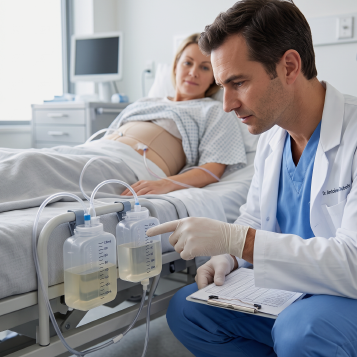 The volume collected in the drains
That reading guides the decision to take the drains out or leave them in. It bears directly on the date when going home becomes possible, and it appears in the report you are given in English.
-
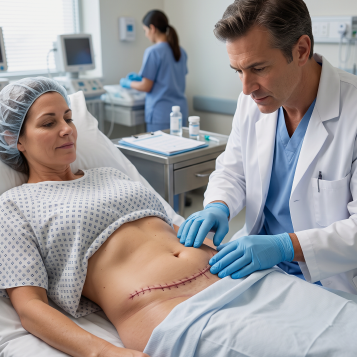 The look of the suture line
The surgeon judges the colour of the wound edges, the absence of excess tension and how the stitches are holding. That is also when the dressing routine you will carry on with at home is set out.
-
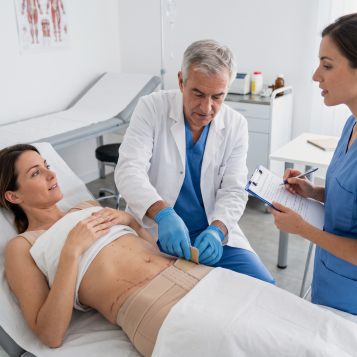 The fit of the compression garment
The garment is readjusted if it has shifted or if the swelling has changed. Your English-speaking coordinator goes through when to wear it and when to take it off to wash, then puts it in writing.
-
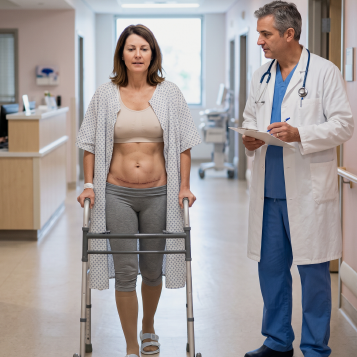 Your walking and your breathing
Standing up, walking a few dozen metres and breathing without discomfort are part of the examination. They are among the things that decide whether the surgeon clears you for a flight.


Discussing your project

Tummy tuck in Istanbul: the calendar set by the drains
A tummy tuck carried out in Istanbul plays out across three places: your home, where the file is put together and where convalescence ends; our partner clinic, where the indication is confirmed and where the operation happens; the hotel, where the days between theatre and the discharge appointment pass. Surgical techniques, general indications and the detailed recovery belong to the tummy tuck guide, while the national offer and its patient journey are set out on the tummy tuck in Turkey page. What follows deals with one question only: what the geography of the stay imposes on the calendar of this surgery.
That calendar comes down to a piece of physiology. A tummy tuck leaves behind a space where the tissue was lifted, which the body takes several days to fill, and drains collect the fluid that forms there. The surgeon clears you to fly once that output has dropped low enough for the drains to come out. So the length of the stay is set by a clinical examination, and its date becomes clearer as you recover.

What the surgeon’s hands add to the photographs
Two photographs of the stomach taken standing, one from the front and one in profile, open the file. Alongside them go your surgical history, the medication you take, whether you smoke and any plans for pregnancy. From these the surgeon reads the height of the excess skin, how it sits above and below the navel, and the general condition of the skin. That first reading produces an opinion and a price, sent free of charge within 24 hours and with no obligation.
Three things escape the camera. The firmness of the muscle wall, and so whether the rectus muscles have separated, is felt with a hand on the stomach. How the skin pinches and lifts, which governs the tension at closure, is judged the same way. The depth of any existing scars and how freely the tissue around them moves call for a direct examination. All three are picked up by hand, and that examination happens in Istanbul.
Which is why the plan drawn up remotely stays a working plan. It sets an intention, a range and an organisation, and it leaves the surgeon room to adjust after examining you. Any change is explained to you in English, and the quote you already have is updated if the extent decided on differs from what the photographs suggested.

The check-up that decides the operating date
It starts at the arrivals terminal, where the driver waiting for you drops your bags at the hotel before heading to the clinic. The day before the operation belongs entirely to tests. Full blood work and an ECG are done on the surgeon’s request, and the anaesthetic consultation settles the protocol along with the fasting asked of you for the following morning. Your English-speaking coordinator comes to each of these appointments and writes down the instructions that apply to you.
Then comes the hands-on examination. The surgeon judges the elasticity of the skin, looks for a gap between the rectus muscles, compares one flank with the other and decides whether the removal will cover the area below the navel alone or the whole front of the abdomen. The case for extra work on the waist is weighed up at the same time. This examination sets the surgical approach, and it sets the monitoring that follows: the wider the planned undermining, the more the drain output will dominate the days afterwards.
Two preparations, on the other hand, are yours, and they are best sorted before you board. The first is the prescribed compression garment, sized from your own measurements, which has to be ready the moment you leave theatre. The second is having someone with you, which the surgeon usually recommends, because the first times you get up, washing and the trips to the clinic all go better with a second pair of hands. Both appear in the instructions your English-speaking coordinator sends once the date is confirmed, and they save you improvising in Istanbul what can be arranged calmly from home.
The same appointment checks the general safety conditions. Smoking that hasn’t stopped, poorly controlled diabetes or high blood pressure, a clotting disorder, a weakened immune system or an ongoing pregnancy all lead the surgeon to postpone. A postponement decided at that point rests on objective results, and the team then reworks the calendar with the clinic and with the hotel.

Seroma, the target of the operation itself
Fluid gathering in the space created by the undermining is the most common complication of this surgery. A meta-analysis of nine controlled prospective studies covering 664 patients shows that preventive surgical measures bring the rate down from 19.5% to 7.5%, an odds ratio of 0.26 (Seretis, Goulis, Demiri & Lykoudis, 2017). Preserving Scarpa’s fascia, the connective layer inside the fat beneath the skin, and using tissue glue each cut seroma formation on their own.
The same work reports two effects that matter directly to a patient travelling from abroad: the drains come out sooner, and the hospital stay is shorter. Put another way, decisions taken in theatre in Istanbul show up afterwards in your diary. A cavity treated with these measures drains for less time, which brings the discharge appointment forward and, with it, the moment going home becomes possible.
That mechanism explains why the choice of clinic turns so much on how often the team performs this particular operation. A literature review on complications after abdominoplasty, with or without liposuction alongside it, concludes that the procedure is safe and that satisfaction rates are high, while adding that the incidents arising during and after surgery call for a surgical team ready to deal with them (Vidal, Berner & Will, 2017). On a trip abroad that readiness carries particular weight: the surgeon who operated is the one who sees you at the check, in the same building, with the operating report in front of them.

Why removing the drains governs the flight home
The days spent at the hotel between theatre and the discharge appointment have a precise job. They give the drain output time to fall, the tissues time to settle back down, and the pain time to ease under the prescribed painkillers. They are built around lying slightly bent at the hips, wearing the compression garment without a break, and short but repeated walks in the room and then along the corridors. Every trip to the clinic is by car with a driver, which spares you public transport, queues and long spells on your feet, none of which a freshly closed abdominal wall takes well.
The appointment before you leave settles it. The surgeon judges the volume collected in the drains, decides whether they come out, inspects the suture line, readjusts the garment and checks that you walk and breathe without discomfort. That is when you are handed the prescriptions, the dressing routine and the washing instructions, translated by your English-speaking coordinator. A return date pushed back at this stage means extra nights, which the team arranges with the hotel.
Those days also produce the evidence the decision rests on. The volume collected is recorded daily on a monitoring chart, dressings are changed according to the routine set in theatre, and temperature and pain are noted. Your English-speaking coordinator passes this on to the surgeon between appointments and flags anything outside the expected range straight away, whether that is output rising on one side, a fever, or pain that holds out against the painkillers.
The flight itself is part of the thinking. In the CosmetAssure cohort, suspected or confirmed venous thromboembolism accounts for 20.2% of the major complications recorded after abdominoplasty (Winocour et al., 2015). Sitting still for hours on a plane belongs in that picture, and it is why walking early, wearing the compression garment and taking the anticoagulant the surgeon prescribes all matter. The clearance to travel home therefore reflects a clinical state observed at the last appointment.

What the CosmetAssure series changes about organising the stay
A cohort of 25478 abdominoplasties drawn from the CosmetAssure database over 2008-2013 puts major complications at 4.0%, against 1.4% for all the other cosmetic operations in the same registry. Haematomas make up 31.5% of them and infections 27.2%. Both categories share a feature that helps anyone travelling: they show themselves on examination, through colour, tension at the wound edges, local warmth or lopsided drain output. That is exactly what the check scheduled before your flight looks for, and what your English-speaking coordinator is there to report between appointments.
The same publication separates the tummy tuck done on its own, where major complications sit at 3.1%, from the tummy tuck combined with liposuction and body contouring, where the rate climbs to 10.4%. That gap turns into logistics. A combined programme warrants a closer watch on the drains, the garment and getting back on your feet, sometimes an extra appointment before departure, and so a different number of nights. That call belongs to the check-up day, so the morning of surgery does not have to reopen it.

The four factors read at the arrival check-up
The authors of that series keep four independent risk factors: male sex, with a relative risk of 1.8; an age of 55 or over at 1.4; a body mass index of 30 or more at 1.3; and the combined nature of the procedure at 1.5. The first three are fixed by the time you land. The fourth stays in the surgeon’s hands and in yours, since it depends on what you decide to put into the same operation.
That split gives the check-up day its real function: deciding the content of the operating programme in the light of characteristics the file has already recorded. A patient who carries two of those three fixed characteristics is more likely to see the project brought back to the tummy tuck alone, with the extra work on the waist put off. The quote is updated in the same movement, and you are told before you sign.

The twelve months that follow your landing
The discharge appointment closes the Istanbul chapter. You go home with the compression garment, the prescriptions, the scar care routine and the surgeon’s clearance to fly. The 12-month post-operative follow-up starts there. At regular intervals you send sharp photographs to your English-speaking coordinator, who forwards them to the surgeon along with a note of what you have observed.
This arrangement does three things. It puts a name to anything changing abnormally, such as swelling that comes back, a scar thickening or a lopsided feeling of tightness. It paces your return to activity, from desk work to physical effort, according to what the surgeon sees in the photographs. And it keeps one named medical contact available for as long as your questions last, without you having to rebuild your file with someone new.
Having that contact in English changes the nature of the exchanges. Describing pain, a smell, a change in colour or difficulty walking takes your own vocabulary. The operating report, the prescriptions and the discharge instructions travel home with you in that same language, so your GP or a district nurse can take over local care with nothing left in the dark.

The organisation that makes that check-up day possible
You are operated on in Istanbul, at our partner clinic, selected for its facilities and for its surgeons’ experience in abdominal wall surgery. The package brings together your nights in a 5-star hotel with breakfast, VIP transfers between the terminal, your room and theatre, a dedicated English-speaking coordinator who follows your file from the first exchange to the last remote review, and post-operative follow-up running for 12 months. Allow 24 hours for your quote, free and without obligation, where the gap against UK pricing can reach 70% savings. Your flight, though, sits outside the package.
Every line of that exists for a surgical reason. Private transfers replace journeys that sit badly with a sutured abdominal wall and a compression garment. Hotel nights are booked so they can absorb a discharge appointment that slips. Having an interpreter present means the anaesthetic consultation, the examination and the dressing instructions are understood in full. The year of follow-up extends, from the UK, the monitoring that began in the hotel room. As for the quote sent within 24 hours, it deliberately comes before you buy a ticket, so you know the exact content of the stay and the range of dates before spending anything on travel.
The division of responsibility stays readable. The indication, the choice of approach, the conduct of the operation and the decision to let you travel home belong to the surgeon alone. Body Expert puts around those decisions the practical conditions that allow them to be taken properly: a whole day cleared for tests, accommodation close to the clinic, a shared language at every appointment and an open channel through the year that follows. That division is worth knowing before you send your first photographs, because it describes exactly what you are committing to and what stays a matter of medicine.
Sources
- Winocour, J., Gupta, V., Ramirez, J. R., Shack, R. B., Grotting, J. C., & Higdon, K. K. (2015). Abdominoplasty: Risk Factors, Complication Rates, and Safety of Combined Procedures. Plastic and Reconstructive Surgery, 136(5), 597e-606e.
- Seretis, K., Goulis, D., Demiri, E. C., & Lykoudis, E. G. (2017). Prevention of Seroma Formation Following Abdominoplasty: A Systematic Review and Meta-Analysis. Aesthetic Surgery Journal, 37(3), 316-323.
- Vidal, P., Berner, J. E., & Will, P. A. (2017). Managing Complications in Abdominoplasty: A Literature Review. Archives of Plastic Surgery, 44(5), 457-468.