Periodontology

A gummy smile, also called excessive gingival display, means that a large amount of upper gum shows when you smile. It can be linked to the position of your teeth, the height of your gums, the mobility of your lip or the structure of your upper jaw. Treatment depends on that cause: an injection, a gingivectomy and jaw surgery do not correct the same mechanism. An assessment lets you choose a proportionate solution, if this feature bothers you.
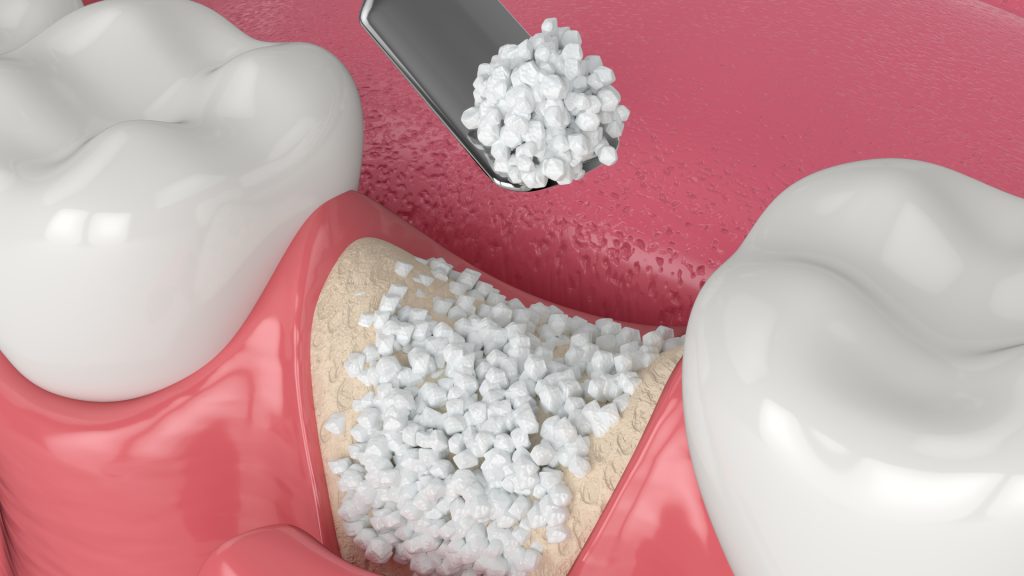
A dental bone graft aims to increase the volume of bone available in one area of the jaw, often to prepare for or accompany the placement of an implant. It is not needed before every implant and can take very different forms, from a small local filling to a more extensive reconstruction. To understand the treatment you are being offered, you need to distinguish between the defect to be corrected, the material used, the technique chosen and the bone maturation time planned.

Periodontitis is the advanced form of gum disease. It is a bacterial infection that provokes chronic inflammation in the tissues holding your teeth in place: the gum, the periodontal ligament that cushions every bite, the cementum covering the roots and the alveolar bone in which those roots sit. It almost always begins as gingivitis, an inflammation limited to the gum that is still entirely reversible, and it becomes a different disease on the day the attachment between tooth and bone gives way.
British mouths are healthier than they were a generation ago, but not in this respect. The Adult Dental Health Survey found that only 17% of dentate adults had a very healthy periodontal status, and that while moderate disease had fallen over the previous decade, the most severe form had not followed (White et al., 2012).
What makes periodontitis difficult to catch is not how common it is but how quietly it works. It progresses for years without pain, and its earliest sign, blood on the toothbrush, is usually blamed on brushing too hard. This guide sets out what separates gingivitis from periodontitis, what the inflammation destroys, which risk factors the research supports, the signs that should take you to a dentist, and how the diagnosis is reached at a British dental appointment.

Periodontal disease is treated in a fixed sequence rather than by choosing from a menu of procedures. Your dentist or hygienist first works on plaque control and the risk factors that keep the inflammation going, then cleans the root surfaces below the gum line, then measures what that cleaning has achieved. Surgery is offered only for the sites that have not responded. Once the gums are stable, supportive care takes over and continues for as long as you keep your teeth. This four-step sequence comes from the European clinical practice guideline (Sanz et al., 2020), which the British Society of Periodontology adapted for UK practice in a set of 62 recommendations mapped onto the 2017 disease classification (West et al., 2021).
The starting point is that periodontal disease is controlled rather than cured. Treatment stops the destruction and allows the gum to reattach, but the supporting bone that has already gone is not rebuilt by the body. Regenerative techniques exist and their results are measured in the literature, yet they apply to one particular shape of defect and never rebuild a whole jaw.
What follows sets out each step of treatment, what it is meant to achieve, when the decision to operate is taken, and what the whole thing costs in the UK.

Advanced gum disease is periodontitis that has already destroyed part of the bone holding your teeth in place. That bone does not grow back on its own, and no mouthwash, toothpaste or course of antibiotics will bring it back. What treatment can do is stop the destruction, settle the inflammation and preserve the teeth that still have enough support around them. When patients are treated and then kept under regular periodontal maintenance, long-term studies show that most of them keep most of their teeth (Graetz et al., 2020).
Periodontitis is a chronic inflammation of the tissues that anchor a tooth: the gum, the periodontal ligament, the cementum covering the root and the alveolar bone. It is common in the UK: the Adult Dental Health Survey found that the proportion of adults with deep pockets of 6 mm or more rose from 6% to 9% between 1998 and 2009 (White et al., 2012). If you have been told that teeth are loose, that pockets are deep or that bone has been lost on the X-rays, you are in that group. The rest of this article explains what the diagnosis means, what the treatment involves, which teeth can realistically be kept, and what has to be true before implants can replace the ones that cannot.

A gum graft is a piece of periodontal surgery in which a small amount of soft tissue, usually taken from the palate, is moved to an area where the gum has receded or become too thin. It answers three separate clinical problems: covering a root laid bare by gingival recession, thickening a gum that is too fine to hold up over time, and rebuilding a band of keratinised tissue around a tooth or an implant. Those three aims call for different techniques and produce different results.
One point needs settling straight away, because it governs everything else. A visible recession does not automatically lead to surgery. Plenty of exposed roots stay unchanged for years in people whose cleaning is effective, and monitoring the site answers the situation better than operating on it. Surgery earns its place when the recession is progressing, when it makes brushing difficult, when sensitivity persists, or when the loss of gum shows in the visible part of the smile.
What follows covers the real indications, the techniques and what separates them, how the operation is carried out, what recovery is actually like including at the palate, and finally what a graft costs and how it is paid for in the UK. For the wider picture of restoring your teeth, the main page is the place to start.
On discute de votre projet